
Key Facts
| Fact | Detail |
|---|---|
| UNESCO status | World Heritage Site — inscribed 1987 |
| Type | Ksar (fortified village) — not a single kasbah |
| Built | From the 11th century |
| Location | Southeastern Morocco, on the Ounila River |
| From Ouarzazate | 30 km / ~30 minutes |
| From Marrakech | 180 km / 3.5–4 hrs via Tizi n’Tichka |
| Entry fee | FREE — no ticket required |
| Visit duration | 1.5–2 hours |
| Famous films | Gladiator, Game of Thrones (Yunkai), The Mummy, Prince of Persia |
| River | Ounila River — cross via stepping stones or footbridge |
| Best season | Spring (Mar–May) and autumn (Sep–Nov) |
| MDT tour | Day trip from €21 · Included on every desert tour |
Ksar vs Kasbah
Ait Ben Haddou is technically a ksar (Arabic: قصر, plural ksour) — a fortified village containing multiple dwellings, communal areas, granaries, a mosque, and defensive walls. A kasbah, by contrast, is a single fortified house or palace belonging to one family. The distinction matters: a ksar houses an entire community; a kasbah houses one family. In practice, both terms are widely used for Ait Ben Haddou — tourism signs, maps, and guidebooks use “Kasbah Ait Ben Haddou” freely. UNESCO’s official designation is “Ksar of Ait-Ben-Haddou.”
History
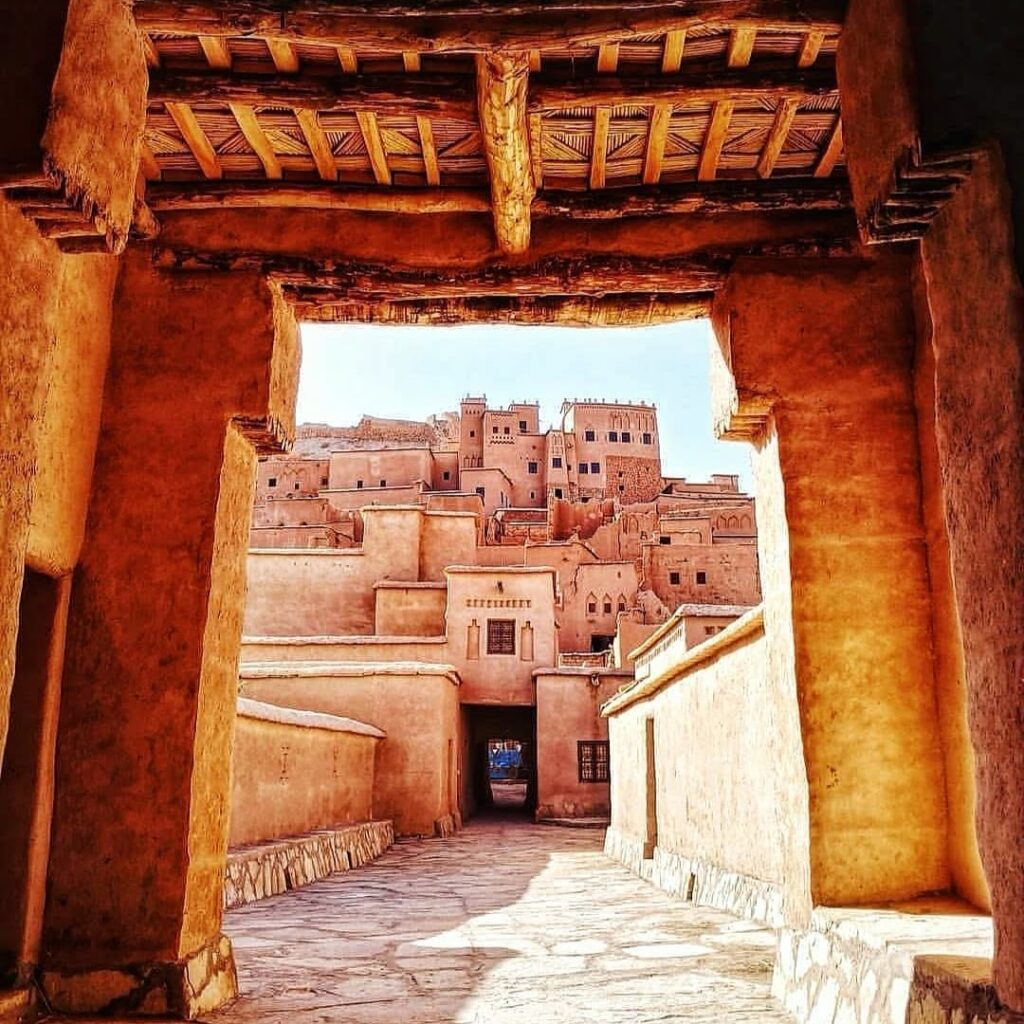
Ait Ben Haddou dates from the 11th century and served as a vital stop on the trans-Saharan trade route — the network of caravan paths linking the Sahara Desert to Marrakech and the Atlantic coast. Traders carried gold, salt, spices, and enslaved people through the Ounila River valley, and Ait Ben Haddou was a key point for rest, trade, and resupply. The ksar’s fortified walls protected the community and its stored goods.
The village reached its peak in the 17th century under the powerful Glaoui family — regional lords who controlled the mountain passes between the Sahara and Marrakech. The Glaoui expanded and reinforced many kasbahs and ksour across the region. Today, Ait Ben Haddou remains the finest and most complete example of ksar architecture in pre-Saharan Morocco — the reason UNESCO inscribed it in 1987.
Films Shot at Ait Ben Haddou
| Film / Show | Year | Role |
|---|---|---|
| Gladiator | 2000 | Scenes of Maximus’s journey through the Roman provinces |
| Game of Thrones | 2012–2014 | Yunkai — “the Yellow City,” Slaver’s Bay |
| The Mummy | 1999 | Ancient Egyptian city scenes |
| Prince of Persia: The Sands of Time | 2010 | Persian city settings |
| Kingdom of Heaven | 2005 | Crusader-era Jerusalem approach |
| Alexander | 2004 | Ancient Middle Eastern landscapes |
| Jesus of Nazareth | 1977 | Biblical-era village scenes |
| Babel | 2006 | Moroccan village sequences |
| The Jewel of the Nile | 1985 | North African adventure settings |
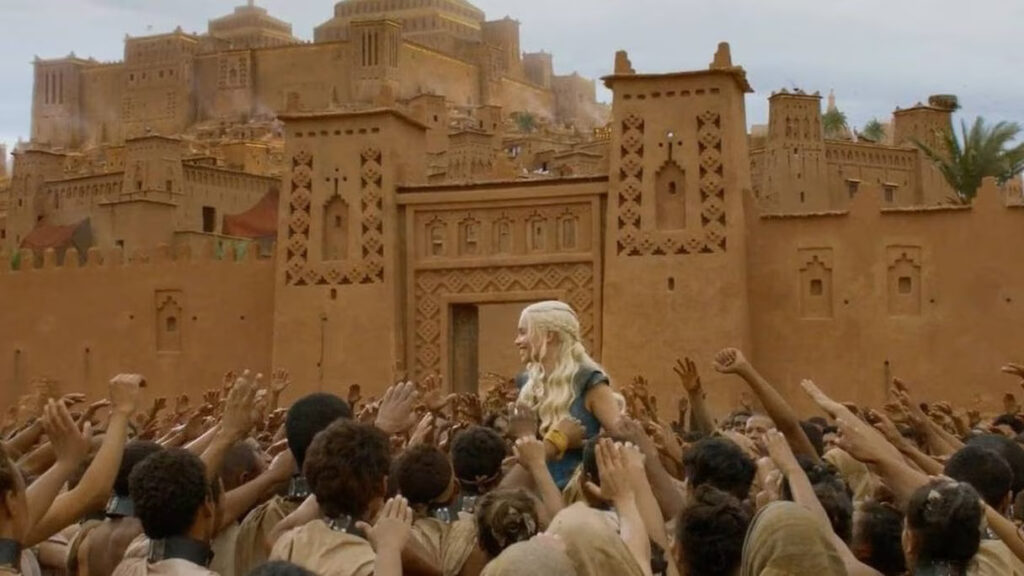
Why filmmakers choose Ait Ben Haddou: The ksar has a timeless appearance — no visible modern structures, power lines, or satellite dishes. It can pass convincingly for ancient Rome, Persia, Egypt, or a fantasy world. The nearby Atlas Film Studios in Ouarzazate (30 km away, founded 1983) provide production infrastructure — props, sets, and crew — making the region Morocco’s filmmaking hub. Ouarzazate earned its nickname “the Hollywood of Africa” for this reason.
Game of Thrones at Ait Ben Haddou
Fans of Game of Thrones will recognise Ait Ben Haddou as Yunkai — the “Yellow City” of Slaver’s Bay. The ksar appears in Seasons 3 and 4 during Daenerys Targaryen’s campaign to liberate the slave cities. The ksar’s ancient fortified walls and dramatic hilltop setting were a convincing stand-in for the fictional city. Walking through the ksar today, the resemblance is unmistakable — especially from the summit, looking down over the walls toward the river.
What to See & Do
| Activity | Time | Notes |
|---|---|---|
| Climb to the hilltop | ~30 min up | Panoramic views of the ksar, river, and mountains. The highlight. |
| Walk the alleys | 30–60 min | Winding lanes, terraced houses, granaries, mudbrick detail. |
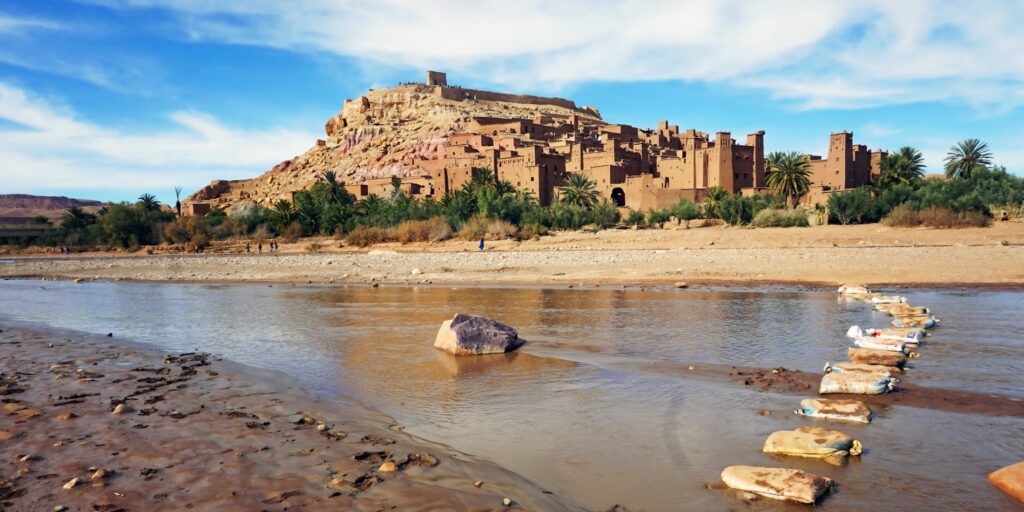
| Cross the Ounila River | 5 min | Stepping stones (dry season) or footbridge. The iconic photo spot. |
| Artisan shops | 20–30 min | Berber crafts, silver, pottery, paintings. Inside the ksar. |
| Photography | All visit | Best light: early morning or late afternoon. Sunset is spectacular. |
| Ouarzazate + Atlas Film Studios | Half day | 30 km away. Studio tours ~50 MAD. MDT day trip includes both. |
| Todra Gorge | Day trip | ~2.5 hrs east. Dramatic canyon. Often combined on desert tours. |
| Skoura Oasis | Half day | ~1.5 hrs east. Palm groves, kasbahs. Road to the desert. |
Architecture & UNESCO
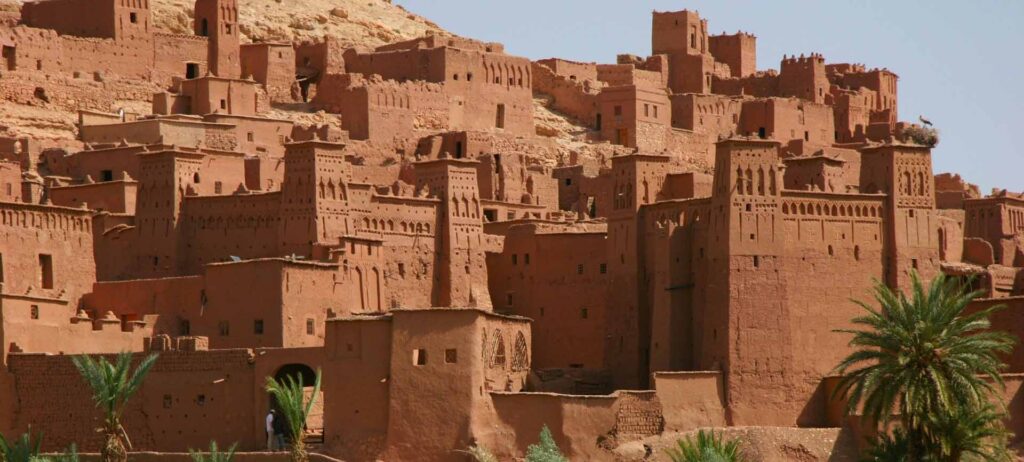
Ait Ben Haddou is built from pisé (tabya in Arabic) — a traditional earth-and-straw construction technique that has been used in southern Morocco for centuries. The walls are thick, providing natural insulation against the extreme desert heat. The ksar is a layered structure: terraced houses climbing the hillside, connected by narrow alleys and stairways, with communal granaries (ighrems) at the top for secure grain storage. A mosque, open squares, and defensive towers complete the layout.
UNESCO inscribed Ait Ben Haddou in 1987 as the finest example of ksar architecture in the pre-Saharan region. The earthen structures are vulnerable to erosion — heavy rains and climate change pose ongoing threats. Restoration projects funded by UNESCO and the Moroccan government have stabilised key sections, but the work is continuous. Visitors are encouraged to walk carefully, stay on marked paths, and not lean on fragile walls.
Visiting: Practical Info
Entry: FREE — no ticket required. One of the few UNESCO World Heritage Sites in the world with completely free access. The ksar is open daily from sunrise to sunset.
Duration: 1.5–2 hours is typical. Cross the river, explore the alleys, climb to the summit, browse the artisan shops, and take photos. Photography enthusiasts may spend longer.
Guides: Unofficial local guides offer their services at the entrance — typically ~100–150 MAD (€10–15). They are knowledgeable about the history and architecture but are not mandatory. Decide before entering to avoid repeated offers inside.
What to bring: Comfortable shoes (steep, uneven terrain), water, sun protection, and a camera. There are no shops inside the ksar selling water — buy before crossing the river.
Living residents: A few families still live inside the ksar, maintaining a traditional way of life. Most of the population has moved to the modern village across the Ounila River, which has restaurants, cafés, souvenir shops, and parking.
How to Get There
From Marrakech: 180 km / 3.5–4 hours via the Tizi n’Tichka mountain pass (N9) — one of Morocco’s most scenic drives, crossing the High Atlas at 2,260 m. The best option is MDT’s Ouarzazate & Ait Ben Haddou day trip from €21, which includes transport, a guide, and a stop in Ouarzazate.
From Ouarzazate: 30 km / ~30 minutes. A quick taxi ride (~100–150 MAD) or a short drive.
On a desert tour: Ait Ben Haddou is the Day 1 stop on every MDT desert tour — whether heading to Zagora, Merzouga, or Erg Chigaga. You’ll visit it as part of the journey south, before continuing to the desert. No separate trip needed.
By bus: CTM operates daily buses from Marrakech to Ouarzazate (~4 hours, ~80 MAD), then a taxi to Ait Ben Haddou (30 km). No direct bus service to the ksar itself.
Best Time to Visit
Spring (March–May): Best season — mild temperatures (18–28°C), clear skies, the Ounila River flowing well. Green vegetation on the surrounding hills.
Autumn (September–November): Equally good — warm, comfortable, golden light. Post-summer, fewer crowds.
Summer (June–August): Very hot (35–45°C). Visit early morning only. The climb to the summit is brutal in midday heat.
Winter (December–February): Mild days (15–20°C) but cold nights. Potential for snow on the Tizi n’Tichka pass — check road conditions. Quietest season.
MDT Tours
| Tour | Duration | Route | From |
|---|---|---|---|
| Ouarzazate & Ait Ben Haddou | 1 day | Marrakech → Tizi n’Tichka → ABH → Ouarzazate → return | €21 |
| 2-Day Zagora Desert Tour | 2 days | Includes ABH on Day 1, continues to Zagora | €69 |
| 3-Day Merzouga Desert Tour | 3 days | Includes ABH on Day 1, continues to Merzouga | €95 |
What: UNESCO World Heritage ksar (1987). Fortified village, not a single kasbah.
History: 11th century, trans-Saharan trade route, Glaoui family, 17th C peak.
Films: Gladiator, Game of Thrones (Yunkai), The Mummy, Prince of Persia, + 5 more.
Entry: FREE. Duration: 1.5–2 hrs. Guides: ~100–150 MAD (optional).
Getting there: Marrakech 180 km / 3.5–4 hrs. Ouarzazate 30 km / 30 min.
MDT: Day trip from €21. Also included on every desert tour (Day 1).