
The Golden Rule: One Small Bag
Leave your main suitcase at your Marrakech riad (most store luggage free). Take only a small backpack or soft overnight bag with 2–3 days of essentials. Your bag goes on the vehicle roof rack during the drive and is carried by camel or 4×4 to the desert camp. Hard-shell cases are impractical — the camp is in sand dunes.
Season-Specific Packing Table
The Sahara’s temperature range is extreme — 3°C winter nights to 48°C summer afternoons. Your packing list depends entirely on when you travel. Use this table as your master checklist.
| Item | Spring (Mar–May) | Summer (Jun–Aug) | Winter (Dec–Feb) |
|---|---|---|---|
| Sunscreen | SPF 50+ | SPF 50+ (reapply hourly) | SPF 30+ |
| Hat | Wide-brimmed | Wide-brimmed + neck flap | Warm beanie + sun hat |
| Sunglasses | Polarised + strap | Polarised + strap | Polarised + strap |
| Day top | Light long-sleeve | Lightest UV shirt | Warm layer + light top |
| Evening layer | Fleece or jumper | Light jumper | Down jacket + fleece |
| Trousers | Loose cotton/linen × 2 | Loose, lightest possible | Warm trousers + thermals |
| Camp night | Warm PJs + socks | Light sleepwear | Thermals + hat + gloves |
| Shoes | Closed trainers | Closed trainers | Warm boots + trainers |
| Scarf/buff | ✅ (sun + sand) | ✅ (essential) | ✅ (warmth + sand) |
| Electrolytes | Optional | Essential (pack 6+) | Optional |
| Hot water bottle | No | No | Highly recommended |
| Desert temp range | 10–32°C | 25–48°C | 3–22°C |
Day-by-Day Gear Guide
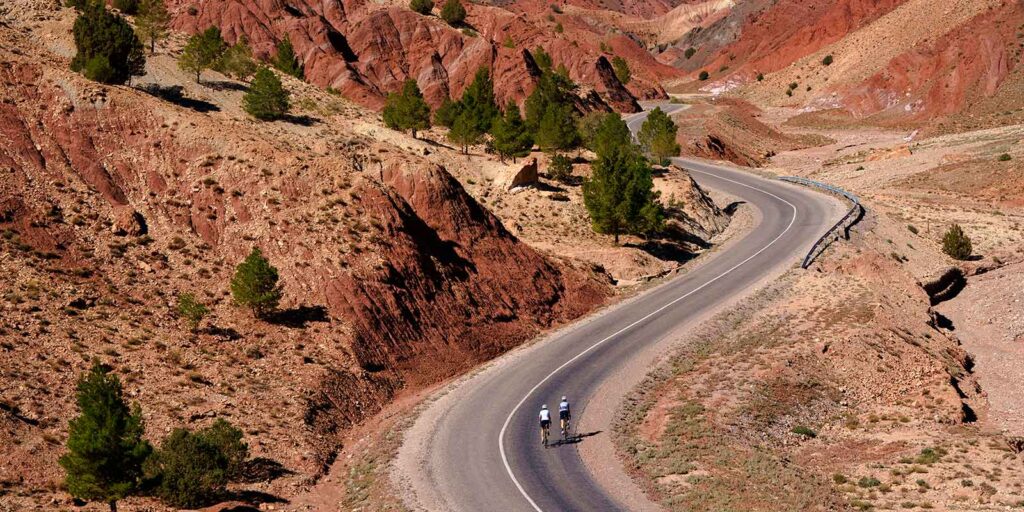
Day 1 — Marrakech → Atlas Mountains → Dades Valley: You cross the Tizi n’Tichka pass at 2,260 m — significantly cooler than Marrakech, especially in the morning. Wear layers you can peel off as you descend. Bring a light jacket for photo stops at the pass. The vehicle has A/C. Comfortable clothes for ~6–7 hours of driving with stops.
Day 2 — Todgha Gorge → Merzouga → Camel Ride → Camp: The hottest day — you reach the Sahara. Afternoon temperatures can exceed 40°C in summer. By late afternoon you’re on a camel for 1–1.5 hours to the camp — this is when your gear matters most (see camel section below). After sunset the temperature drops fast. Bring your warm layer to camp — you’ll need it by 9 PM.
Day 3 — Sunrise → Long Drive Back: Optional sunrise walk at ~5:30 AM — bring something warm + your phone/camera. Then ~8–9 hours driving back. Comfortable clothes, snacks, headphones, a book or playlist. Charge your phone the night before or use your powerbank.
What to Wear for the Camel Ride
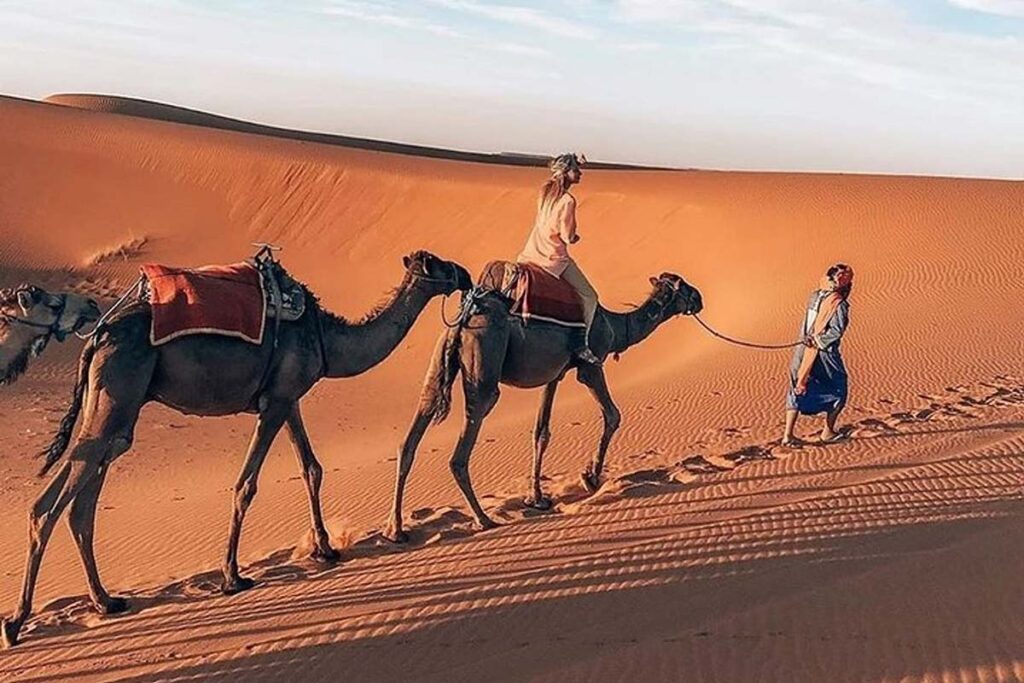
The camel ride is 1–1.5 hours each way across sand dunes. What you wear matters for comfort and safety.
| ✅ Wear | ❌ Avoid | Why |
|---|---|---|
| Loose cotton/linen trousers | Jeans, tight trousers | Jeans chafe badly after 30+ minutes in the saddle |
| Closed-toe shoes/boots | Flip-flops, sandals, heels | Sand burns feet, scorpions at dusk, shoes can fall off camel |
| Sunglasses with strap | Loose sunglasses | Camel’s gait bounces — glasses fall into dunes |
| Scarf/buff over nose | Nothing covering face | Sand blows at dune crests, especially with wind |
| Long sleeves | Bare arms in summer | Sun exposure is intense from camel height |
| Small crossbody bag | Backpack | Backpack unbalances you on the camel; crossbody stays secure |
Camp Night Essentials
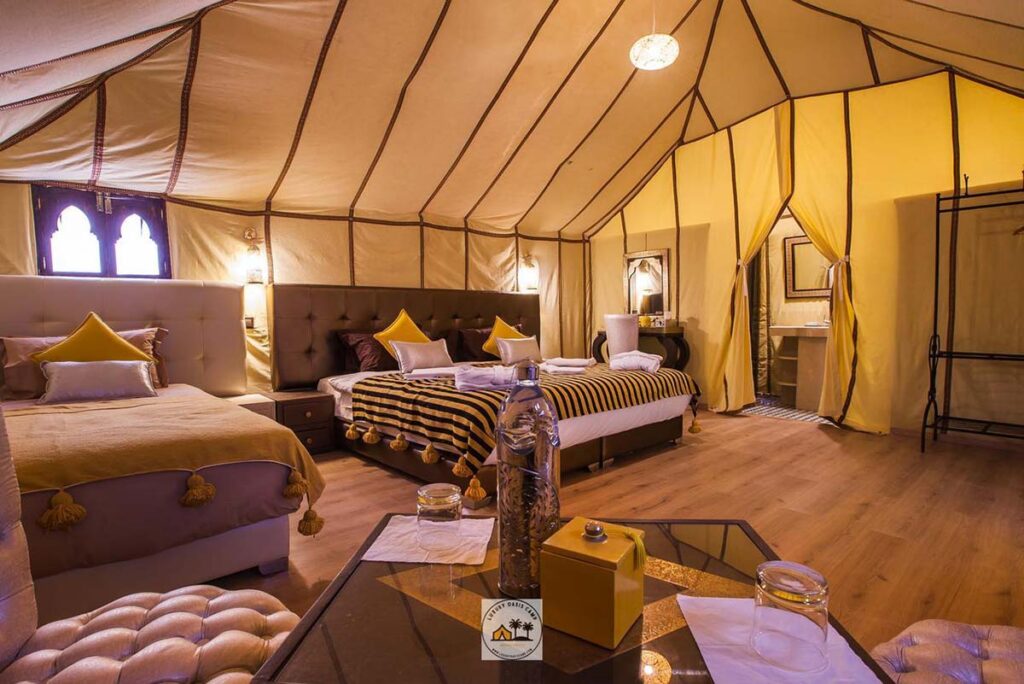
You spend one night in a Sahara desert camp — either standard (shared facilities) or luxury (private en-suite). What you need depends on the camp type.
| Item | Luxury Camp | Standard Camp | You Bring |
|---|---|---|---|
| Bed + blankets | ✅ Real bed + duvet | ✅ Mattress + blankets | Warm base layer (winter) |
| Pillows | ✅ | ✅ (basic) | — |
| Toilet | ✅ Private en-suite | Shared (outside tent) | Flip-flops for bathroom |
| Hot shower | ✅ | Sometimes (basic) | Wet wipes as backup |
| Towels | ✅ | Sometimes | Microfibre towel |
| Toiletries | ✅ (basic set) | ❌ | Toothbrush, face wash, deodorant |
| Electricity | Limited (solar) | Limited / none | Powerbank (10,000 mAh+) |
| Heating (winter) | Some camps have heaters | ❌ | Thermals, hat, socks, hot water bottle |
| Light | Candles / solar lamps | Minimal | Headtorch (essential) |
| Dinner + breakfast | ✅ (refined) | ✅ (traditional) | — |
Photography & Electronics
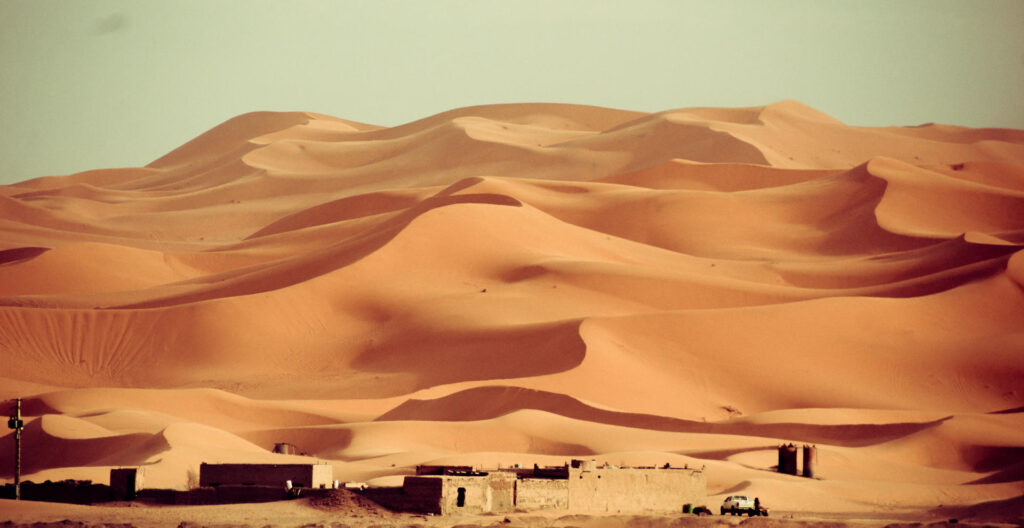
Phone cameras work brilliantly in the Sahara — the light is extraordinary at sunrise and sunset (golden hour). If you bring a dedicated camera, here’s what to know:
Protect from sand: Fine Sahara sand gets into everything. Keep your camera in a zip-lock bag or padded pouch when not shooting. Change lenses inside your tent, never in the open wind. A UV filter on your lens protects the glass.
Spare batteries: Cold desert nights drain batteries fast. Keep a spare battery warm in your pocket. Charge everything the night before at your Day 1 guesthouse (reliable electricity) — the camp has limited or no charging.
Powerbank: Bring at least 10,000 mAh — enough for 2–3 full phone charges. Solar powerbanks are unreliable; standard ones are better.
No drones: Flying a drone in Morocco requires a permit from the DGAC (Directorate General of Civil Aviation). Flying without a permit is illegal and drones can be confiscated at customs. Leave it at home.
What NOT to Bring
| ❌ Don’t Bring | Why | ✅ Instead |
|---|---|---|
| Big suitcase | Impractical on camel + sand | Small backpack / soft overnight bag |
| Jeans | Chafe on camel, heavy, slow-drying | Loose cotton or linen trousers |
| Flip-flops (as main shoes) | Sand burns, scorpions, fall off camel | Closed trainers + flip-flops for camp bathroom only |
| Drone | Illegal without DGAC permit; confiscated at customs | Phone / action camera |
| Excessive cash / valuables | Leave in riad safe | ~500–1,000 MAD for tips + souvenirs |
| Heavy books | Weight + sand damage | Downloaded audiobook / playlist |
| Full-size tripod | Too bulky for camel | Mini tripod or phone grip |
| High heels / dress shoes | Sand dunes | Comfortable trainers |
Women-Specific Tips
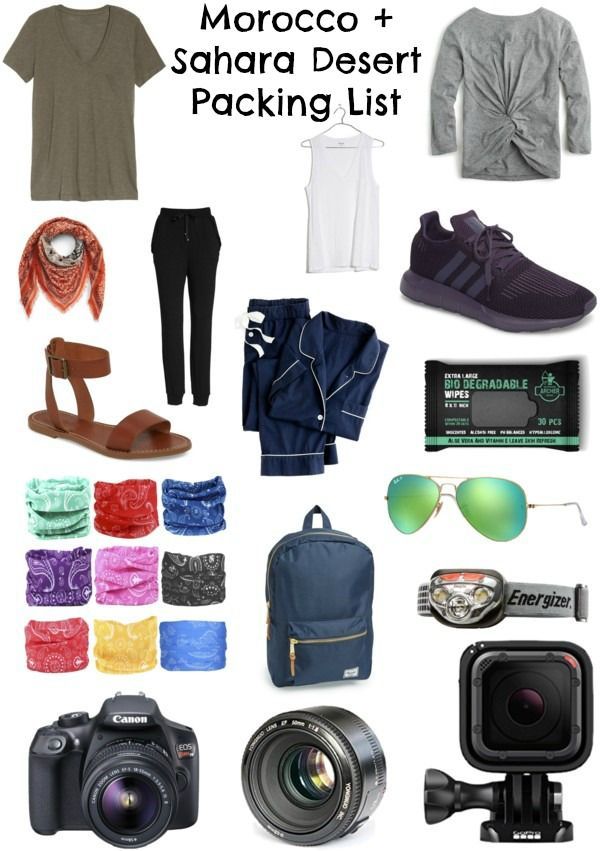
Modest dress: Morocco is a Muslim country. Outside tourist areas, covering shoulders and knees is respectful — and practical in the desert (sun protection). A lightweight scarf is the most versatile item: sun shade, sand cover, mosque entry, and warmth at night.
Practical items: Hair ties and clips (wind), menstrual products (not always available en route), dry shampoo (limited showering), a sports bra for the camel ride (more support than a regular bra during the bouncy gait), and a small mirror.
Camel riding: Loose trousers work best — avoid skirts or dresses. Some women prefer leggings under a long tunic for modesty and comfort. Absolutely no jeans.
What MDT Provides
You don’t need to pack food, water, sleeping bags, or camping equipment. Here’s what’s included on every MDT desert tour:
In the vehicle: Bottled water (restocked at every stop), A/C, phone charging via USB, comfortable seating. Your overnight bag rides in the boot or on the roof rack.
At meals: All dinners and breakfasts are included. Lunch is typically at a roadside restaurant (pay directly, ~60–80 MAD for a tagine). Vegetarian options are available — notify MDT when booking.
At the desert camp: Blankets, pillows, bedding. Traditional Berber dinner + campfire + music. Sunrise wake-up call. In luxury camps: private en-suite, hot shower, towels, toiletries, heating (winter). In standard camps: shared facilities, basic but clean.
Camel ride: Camel, saddle, guide. The trek is 1–1.5 hours each way. If you prefer not to ride, a 4×4 transfer is available on private tours.
MDT Desert Tours
| Tour | Duration | Camp | From |
|---|---|---|---|
| Shared 3-Day Merzouga | 3 days | Standard (luxury upgrade available) | €95 |
| Private 3-Day Merzouga | 3 days | Luxury included | €195 |
| Shared 2-Day Zagora | 2 days | Standard | €69 |
| 4-Day Erg Chigaga | 4 days | Luxury | €275 |
| Marrakech to Fes via Desert | 3 days | Luxury | €225 |
Bag: One small soft backpack/overnight bag. Leave main suitcase at your Marrakech riad.
Essentials (all seasons): SPF 50+, wide hat, sunglasses + strap, loose trousers, closed shoes, scarf/buff, warm layer, headtorch, powerbank 10,000 mAh+.
Winter extra: Down jacket, thermals, beanie, gloves, warm socks, hot water bottle.
Summer extra: Electrolytes (6+), lightest UV clothing, neck-flap hat.
Camel ride: Loose trousers (NOT jeans), closed shoes, sunglasses strap, scarf over nose, crossbody bag.
Don’t bring: Big suitcase, drone, jeans, flip-flops as main shoes, excessive cash.
MDT provides: Water, all meals, blankets, camel trek. Luxury camps add en-suite, hot shower, towels, heating.