Classic Morocco Itinerary – 7 Days: Casablanca, Fes & Marrakesh
- Private vehicle & driver — Pick-up at your riad, pace set by you
- Local licensed guide — Licensed guide nº2898 · since 2011
- Book on WhatsApp — Reply within 1 hour · no payment at this stage
- Chefchaouen AND the Sahara in a single week
- The blue city at dawn — you sleep there, day-trippers don't
- Volubilis and Meknes woven into the Fes road


A private 7-day tour from Casablanca: from €1050 per person, with vehicle, driver, licensed guide and accommodation included — no groups, departures on your dates. Along the way: Chefchaouen, Fes and Meknes.
| Duration | 7 Days |
| Price | From €1050 per person — car, driver and accommodation included |
| Departures | Your dates — every departure is private, never a shared group |
| Languages | English- and French-speaking driver-guides; licensed city guides where included |
| Booking | WhatsApp +212 661 454 738 — written quote within 1 hour, no payment at this stage |
Seven days from Casablanca to Marrakech that refuse to choose between the blue city and the dunes — this route takes both. Chefchaouen on night one, Fes by way of Volubilis and Meknes, the great crossing to an Erg Chebbi camp, and the kasbah road over the Atlas into the Red City. It is the full north-plus-Sahara arc at one-week pace.
What distinguishes it from our other week-long grand tour is the opening: instead of a second Casablanca day, you sleep in the Rif on the first night — which buys a Chefchaouen dawn, the north’s best moment, at the cost of one longer arrival drive. Travellers who love mountains as much as monuments choose this version.
Fully private: vehicle and driver-guide door to door, licensed guides in Fes, ensuite desert camp, riads within the medinas.
The seven-day version of our Casablanca-to-Marrakech arc, for travellers with exactly a week: Chefchaouen’s blue streets on day one, Volubilis and Meknes on the road to Fes, a guided day in the medieval medina, then Erfoud and the Merzouga dunes, the oases road to Ouarzazate, and Aït Ben Haddou before the final run into Marrakech. From €1050 per person, everything but lunches included.
Compared with the 9-day version, this one moves faster through the north — Chefchaouen is an afternoon, not a stay — to protect the desert night and a full Fes day. It is the tightest itinerary that still earns the name “a taste of Morocco”: all four landscapes, no filler days.
Land in Casablanca, fly out of Marrakech, and every road points forward. Private departure on your dates — send them on WhatsApp and the full quote, hotels named, comes back within the hour.
Who this tour is for: first-timers with one week who want the classic Casablanca–Fes–Marrakech arc at a civilised pace, desert optional. Add the dunes with the 7-Day Morocco Tour from Casablanca (camp night included); with nine days, the Morocco Itinerary 9 Days breathes easier still.
Call it what it is: the fast-paced week. Seven days, one honest sprint through Chefchaouen, three imperial cities’ worth of medinas, a night in a desert camp with Berber drums by the fire, and Jemaa el-Fna at full boil for the finale. The trade is explicit — day four is a long, early road to the dunes — and the reward is the full postcard set in a single week of leave. Travellers with three more days should compare the 10-day grand tour, which breathes where this one strides.
- Chefchaouen AND the Sahara in a single week
- The blue city at dawn — you sleep there, day-trippers don't
- Volubilis and Meknes woven into the Fes road
- Guided day in Fes el-Bali, camel trek and Erg Chebbi camp night
- Aït Ben Haddou and the Tichka pass before Marrakech
Photos from the tour


Itinerary
Open a day to see the detail: transport, accommodation, meals and activity time.
Day 1 Casablanca — Chefchaouen
Straight for the mountains: your driver meets you at Casablanca airport and takes the northern road, pausing in Rabat for the Oudayas kasbah and a seafront lunch, then climbing into the Rif as the afternoon softens. Chefchaouen receives you at the blue hour — check into a riad in the lanes, dinner on the square, and set no alarm louder than the mountain light.

Day 2 Chefchaouen — Volubilis — Meknes — Fes
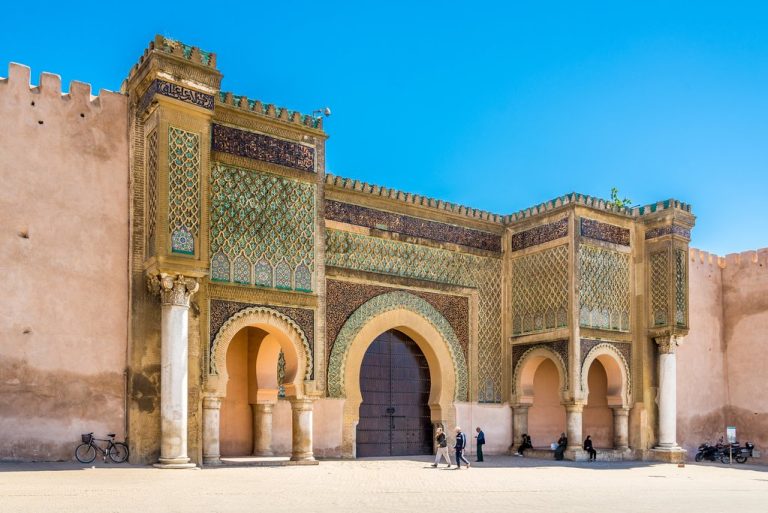
The morning is the payoff: Chefchaouen before the buses, when the alleys hold their deepest colour and the shopkeepers are still arranging the wool. Then south through olive country to Volubilis — a guided hour among Roman mosaics with storks nesting on the columns — and Meknes for the great gate. Fes closes the day, its ten thousand lanes waiting behind your riad door.
Day 3 Fes, the medieval medina
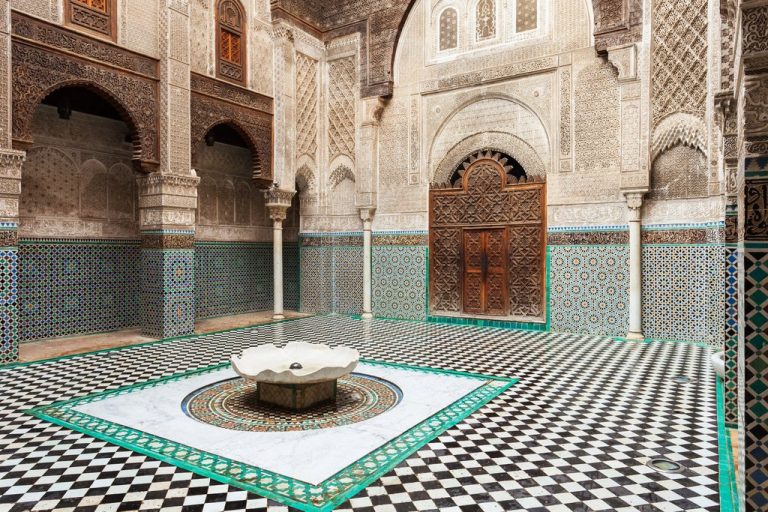
A full guided day inside Fes el-Bali: the blue gate, the madrasas, the tanneries from a leather terrace, the artisan streets where the guild system never ended. Your guide filters the maze into a story; the evening rooftops, swallows included, finish the telling. If you want dinner at a family table tonight, say the word when booking.
Day 4 Fes — Erfoud — Merzouga
The great crossing: cedar forest (Barbary macaques on duty near Azrou), the Midelt plain under Jbel Ayachi, and the Ziz gorges pouring their palm river toward the Sahara. At Merzouga the camels are saddled for golden hour — an hour's sway into the Erg Chebbi, then camp: ensuite tents, dinner under lanterns, drums at the fire, stars in unreasonable quantity.

Day 5 Merzouga — the oases road — Ouarzazate
Up the dune for sunrise — fifteen minutes of climbing, a lifetime of replay value — then west at desert pace: the fossil towns near Erfoud, the Todra Gorge's canyon-floor walk, the Dadès valley's parade of kasbahs. Ouarzazate, Africa's film capital, provides the night and a first taste of the Atlas rising ahead.

Day 6 Ouarzazate — Aït Ben Haddou — Marrakech
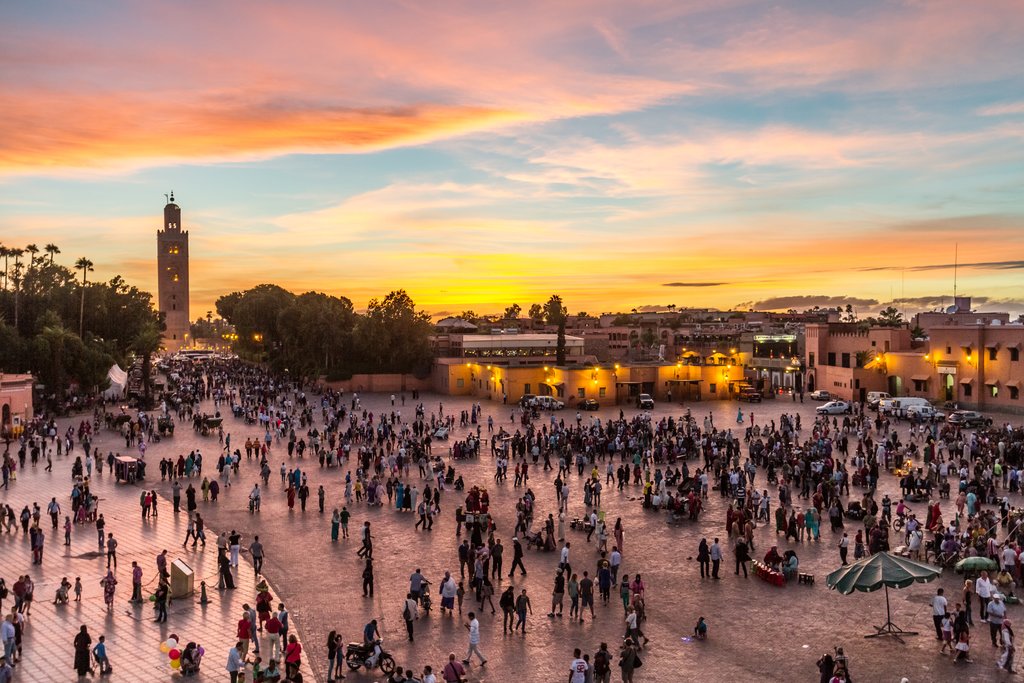
Aït Ben Haddou in the quiet of morning: guided through the UNESCO ksar's earthen lanes to the granary viewpoint before the crowds. Then the Tizi n'Tichka — 2,260 m, mint tea at the belvederes — and the long descent into Marrakech's pink haze. Evening free: Jemaa el-Fna at dusk, ten minutes from your riad, is mandatory in the best way.
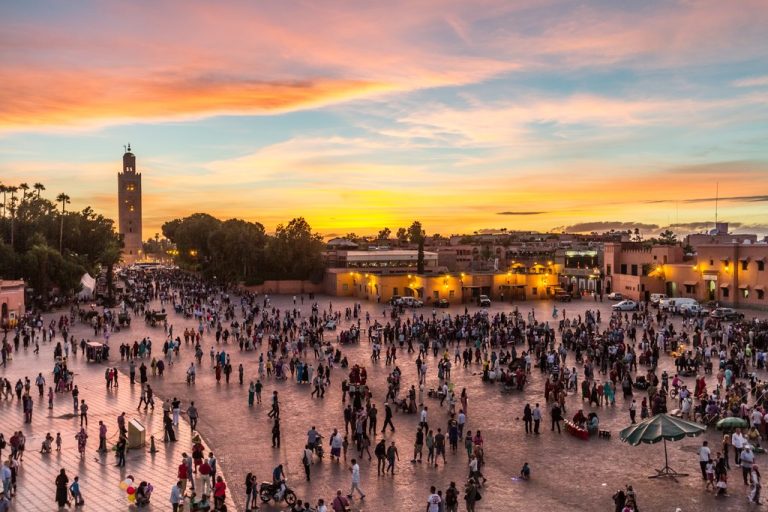
Day 7 Marrakech and departure
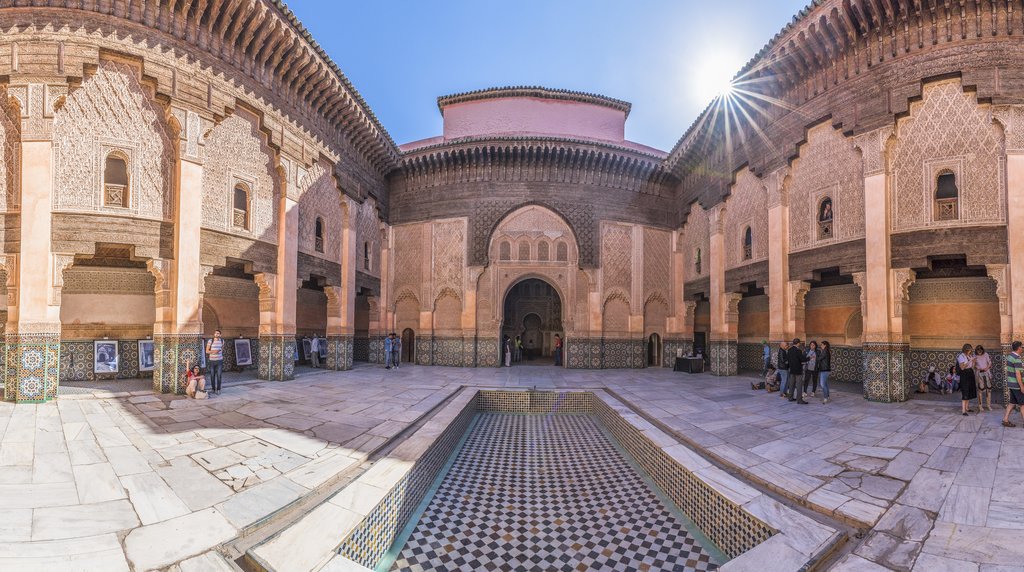
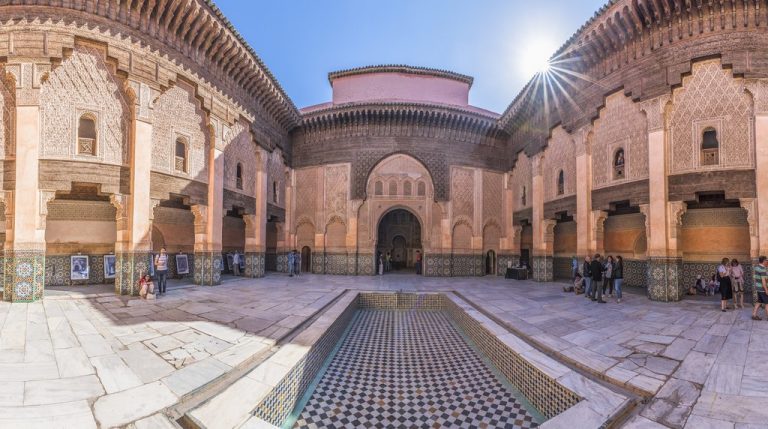
A guided Marrakech morning if your flight allows — Bahia Palace, the souk arteries, the Koutoubia gardens — or simply a courtyard breakfast that refuses to hurry. Airport transfer whenever you must. Seven days: the blue city, the medieval one, the red one, and the desert that connects them.
The first day is the long one (about five hours from Casablanca to Chefchaouen with a Rabat stop) — it buys you the blue city's best hours. Two more long stages frame the desert, both on spectacular roads. October–April is prime; open-jaw flights (Casablanca in, Marrakech out) fit perfectly.
Included in your tour
- Private air-conditioned 4×4 or minivan with English/French-speaking driver-guide — 7 days
- Pickup at Casablanca airport or your hotel
- Night 1: Chefchaouen riad — half-board
- Nights 2–3: Fes riad (2 nights) — half-board
- Night 4: luxury ensuite desert camp — half-board
- Night 5: kasbah hotel, Ouarzazate — half-board
- Night 6: Marrakech riad — half-board
- Guided visit of Fes with a licensed local guide (Day 3)
- Guided visit of the Aït Ben Haddou ksar (UNESCO)
- Camel trek in the dunes
- 4×4 desert excursion
- Drop-off at your Marrakech hotel or at the airport
Not included
- International flights
- Lunches and beverages
- Entrance fees to monuments and historical sites (optional — pay directly)
- Tips for guide and driver
- Personal expenses
- Travel insurance (recommended)
Explore more
Questions travellers ask
How much does Classic Morocco Itinerary – 7 Days: Casablanca, Fes & Marrakesh cost?+
From €1050 per person, per person. The price includes private air-conditioned 4×4 or minivan with english/french-speaking driver-guide — 7 days, pickup at casablanca airport or your hotel, night 1: chefchaouen riad — half-board. You receive a written itemised quote before paying anything — no hidden fees.
How long is this tour and when does it depart?+
7 Days, departing on the dates you choose — there is no fixed schedule, because every departure is arranged for you alone.
Is this a group tour or private?+
Fully private: your own vehicle, driver and licensed guide, never seat-in-coach and never mixed with other travellers. The daily pace flexes around you.
How long does it take to get from Marrakech to Fes?+
Around 530 km: 5 to 6 hours by road across the Middle Atlas, or about 7 hours by train via Casablanca. The scenic answer is to not go direct at all — our 4-day desert crossings link the two cities through Merzouga, turning the transfer into the trip's highlight.
How do you navigate the Fes medina?+
Accept that you will be pleasantly lost, then use the system: the two main arteries (Talaa Kebira and Talaa Sghira) run downhill through the medina, downhill generally leads toward the river and the tanneries, and blue Bab Boujeloud is the compass point. Take a licensed guide the first day — the maze reads like a map afterwards.
Is Fes worth visiting?+
For history, unreservedly: it is the oldest imperial city, home to Al-Qarawiyyin — regarded as the world's oldest continuously operating university — the finest carved madrasas in the country and the famous tanneries. Give it a full guided day plus an evening on the rooftops.
How old is the Fes medina?+
Founded in 789 by Idriss I and built into a capital by his son from 809, Fes el-Bali is over 1,200 years old — and continuously inhabited the entire time, which is the real marvel. Al-Qarawiyyin, teaching since 859, is routinely cited as the world's oldest existing university. When you press against a wall to let a donkey pass, that scene has been running unchanged for a millennium.
More answers in the “Fes” chapter of our Travel FAQ →
Itinerary and prices last updated October 2026.


