Luxury Morocco Tour – 15 Days: Imperial Cities, Sahara & the Coast
- Private vehicle & driver — Pick-up at your riad, pace set by you
- Local licensed guide — Licensed guide nº2898 · since 2011
- Book on WhatsApp — Reply within 1 hour · no payment at this stage
- The full 15-day arc with the finest riads on each stretch
- Guerrouane winery day with cellar visit and tasting lunch
- Private, lantern-lit camp at the Erg Chebbi


The 15-day Luxury Morocco tour costs from €2250 per person and runs Casablanca to Casablanca with fine riads and boutique kasbahs half-board, your own driver for fifteen days, licensed guides in each great medina, a luxury ensuite Sahara camp and a sunrise balloon over Marrakech — entirely private. The shape: the north first (Rabat, Chefchaouen, holy Moulay Idriss, a full guided Fes day, a Guerrouane winery afternoon), then the desert chapter through the Todra Gorge and the Valley of a Thousand Kasbahs, Aït Ben Haddou, two staged Marrakech days, and an Atlantic finish at Essaouira that most luxury itineraries skip. Luxury here means decisions made in advance — tables reserved, hammam booked, best rooms held — not marble lobbies. Every property is named in the written quote before you commit; the quote itself arrives within the hour on WhatsApp.
| Duration | 15 Days |
| Price | From €2250 per person — car, driver and accommodation included |
| Departures | Your dates — every departure is private, never a shared group |
| Languages | English- and French-speaking driver-guides; licensed city guides where included |
| Booking | WhatsApp +212 661 454 738 — written quote within 1 hour, no payment at this stage |
The grand tour, conducted in its finest key: fifteen days from Casablanca through the blue city, Fes, the Sahara and Marrakech to the Atlantic — staged with the best riads on each stretch, a Guerrouane winery day, a dawn balloon over the palmery, and pauses built in precisely where the route earns them.
Luxury here means orchestration rather than ostentation: rooms chosen for their courtyards and rooftops, tables reserved before you land, a desert camp of the private and lantern-lit kind, and a driver-guide who shifts each day around light and crowds. The classics remain the destination; comfort is simply how you travel between them.
Fully private, with licensed guides in each medina and every reservation handled in advance.
Fifteen days with the comfort dial turned up, from €2250 per person: the imperial arc — Rabat, Chefchaouen, a UNESCO Fes day — plus the Guerrouane winery, the Sahara with its camp night, the Todra Gorge and the Valley of a Thousand Kasbahs, and a Marrakech finale that includes a dawn hot-air balloon. Fine riads and the best camps on the route, named in your quote before you pay.
What makes it the luxury version is not marble — it is the extras woven into the days: the winery table, the balloon at first light, guided time in every city, and pacing that never sacrifices an evening to the road.
Anniversary trips and once-in-a-lifetime travellers book this route most. For the romantic 10-day equivalent, see our Royal Morocco journey. Dates on WhatsApp — the full itinerary, hotels named, comes back within the hour.
Who this tour is for: the full-length luxury canvas — fifteen days, every register, staged. The ten-day version is the Luxury Morocco Tour – 10 Days (Royal journey); families wanting comfort without the gala pace should see the Morocco Family Tour – 15 Days.
If you are comparing luxury Morocco tour packages, the honest shortlist question is what ‘luxury’ buys: here it means named riads reserved early, tables booked ahead, a private ensuite Sahara camp and licensed guides throughout — the full 15-day canvas of the best luxury desert tour Morocco offers, in one written price.
The structure beneath the luxury: north first (Rabat, Chefchaouen, the holy town of Moulay Idriss, a guided Fes day), then a Guerrouane winery afternoon before the Sahara chapter, and a finish that most luxury routes skip — two Atlantic days at Essaouira before the coast road home. The balloon floats on the Marrakech morning, the glamping tent waits past the dunes, and every hotel night is named in the written quote before you commit a dirham.
- The full 15-day arc with the finest riads on each stretch
- Guerrouane winery day with cellar visit and tasting lunch
- Private, lantern-lit camp at the Erg Chebbi
- Sunrise hot-air balloon over the Marrakech palmery
- Skoura and the Valley of a Thousand Kasbahs at unhurried pace
Photos from the tour


Itinerary
Open a day to see the detail: transport, accommodation, meals and activity time.
Day 1 Casablanca — Rabat
A private welcome at Casablanca and the soft first act: the coast road to Rabat, check-in at a riad by the kasbah, and dinner already reserved at one of the capital's best tables. The tone is set: nothing to organise, everything arranged.

Day 2 Rabat — Chefchaouen
Rabat's essentials in a guided morning — the Oudayas, the Hassan Tower — then the Rif road north to Chefchaouen for the blue hour. Your riad sits within the lanes; the rooftop aperitif writes itself.

Day 3 Chefchaouen — Moulay Idriss — Volubilis — Meknes — Fes
South through the storybook: holy Moulay Idriss on its hills, Volubilis' mosaics under open sky, Meknes' triumphal gate — arriving in Fes for the first of two nights inside the medieval walls, dinner at a celebrated medina house.
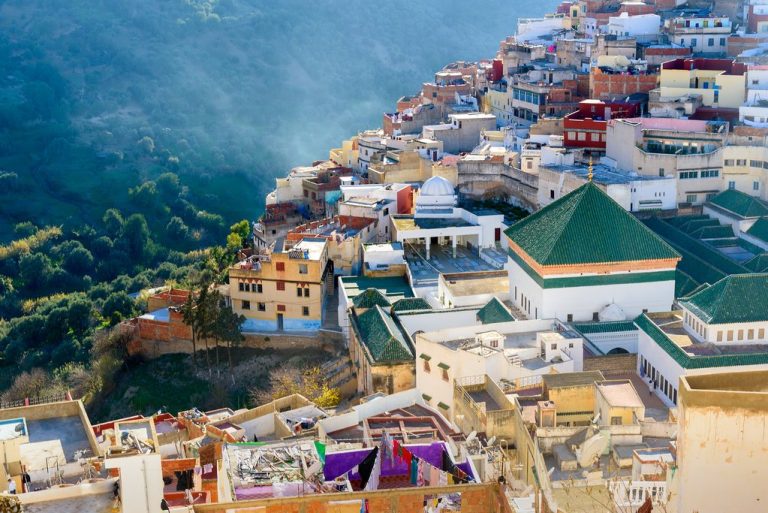
Day 4 Fes and its UNESCO medina
Fes and its UNESCO medina, guided at connoisseur's pace: the madrasas' carved interiors, the tanneries from a private terrace, the artisan ateliers that still take commissions. The late afternoon belongs to a royal hammam ritual — steam, black soap, rose water, silence.

Day 5 The Guerrouane winery
A day among the vines: the Guerrouane appellation near Meknes for a cellar tour and a long tasting lunch between the rows — Morocco's most unexpected luxury, and the route's most talked-about detour. Back to Fes by evening.

Day 6 Over the Middle Atlas to the Sahara
The great crossing, cushioned: the Middle Atlas cedars, Midelt's high plain, the Ziz palm gorges — and at Merzouga, camels at golden hour to a private camp: lanterns, proper linen, a fire that burns for your party alone.

Day 7 The Todra Gorge
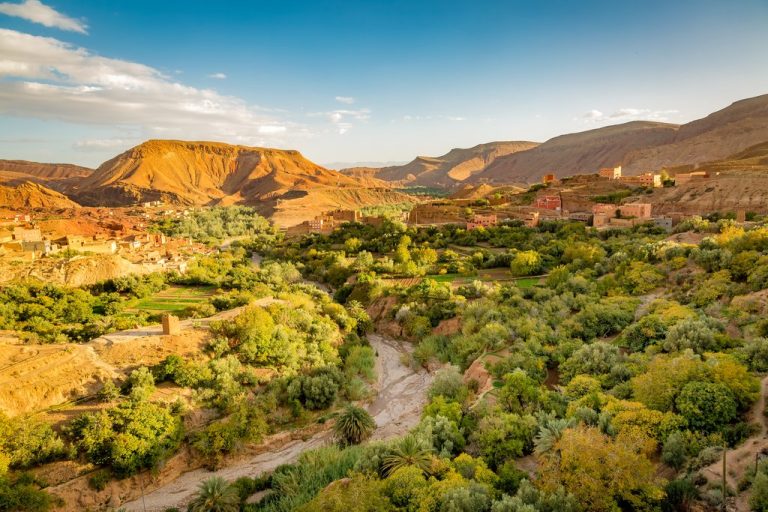
Sunrise from the crest, then a gentle desert exit via Tinghir and the Todra Gorge — the canyon walk between 300-metre walls taken before the day warms. The night settles in a boutique kasbah with the gorge country at the window.

Day 8 The Valley of a Thousand Kasbahs
The Valley of a Thousand Kasbahs, savoured rather than driven: the Dadès fortresses, Skoura's palm oasis and its grand kasbah Amerhidil, and Ouarzazate by evening — with time, always, for the viewpoint that asks for ten more minutes.

Day 9 Aït Ben Haddou — the Tizi n'Tichka — Marrakech
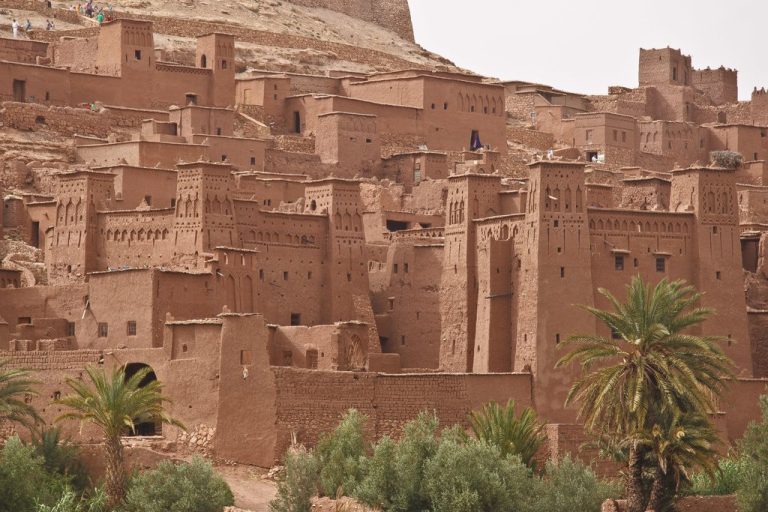
Aït Ben Haddou in morning quiet — guided to the granary while the light is soft — then the Tizi n'Tichka's ceremonial descent into Marrakech. Your riad's courtyard, a hammam if you wish, and dinner reserved at one of the city's great houses.
Day 10 Marrakech, guided
Marrakech unlocked privately: the Bahia's ceilings, the Saadian Tombs, Majorelle with timed entry, and the souks steered toward the ateliers worth your time. The evening rooftop has the Koutoubia exactly where it should be.

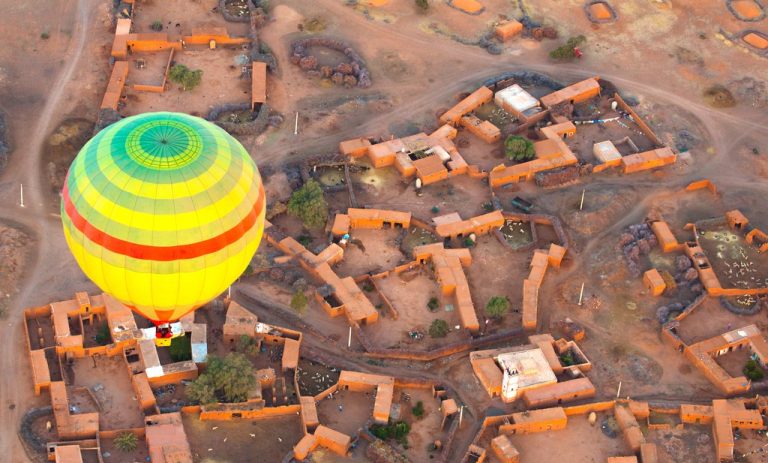
Day 11 Balloon at dawn, afternoon at leisure
Dawn belongs to the balloon — lift-off over the palmery as the Atlas silvers, breakfast on landing — and the rest of the day belongs to no one: pool, spa, a last commissioned purchase, or nothing whatsoever, executed perfectly.
Day 12 Marrakech — Essaouira
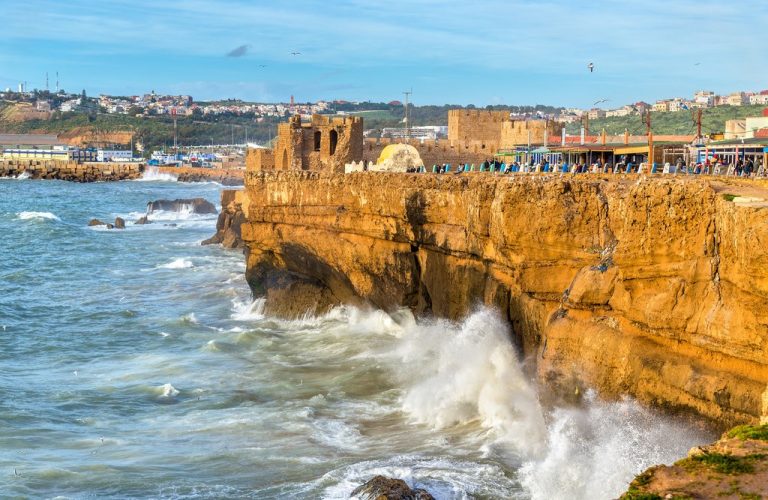
The argan road west with a cooperative pause, then Essaouira: sea light, ramparts, a hotel with the Atlantic in every window. Grilled langoustines for dinner; the wind takes care of the ambience.

Day 13 Essaouira by the sea
Essaouira by the sea, unhurried: a morning ride on the long beach or a gallery drift through the medina, oysters up the coast if the appetite votes, and the ramparts café circuit for sunset.

Day 14 The coast to Casablanca
The coastal return north — Oualidia's lagoon, El Jadida's Portuguese cistern — to Casablanca, where a final ocean-side dinner closes the loop in the register it began.
Day 15 Departure
Departure, arranged to the minute: fifteen days in which the only thing you carried was the daypack — and the impression that Morocco had been expecting you.

Book eight weeks ahead for the signature riads — they are small and famous. Tell us your occasions (anniversary, birthday, proposal) and the route will quietly know. October to May is the season of choice.
Included in your tour
- Private air-conditioned 4×4 or minivan with English/French-speaking driver-guide — 15 days
- Pickup at Casablanca airport or your hotel
- Night 1: Rabat riad — half-board
- Night 2: Chefchaouen riad — half-board
- Nights 3–4: Fes riad (2 nights) — half-board
- Night 5: Meknes riad — half-board
- Night 6: luxury ensuite desert camp — half-board
- Night 7: Tinghir hotel — half-board
- Night 8: kasbah hotel, Ouarzazate — half-board
- Nights 9–11: Marrakech riad (3 nights) — half-board
- Nights 12–13: Essaouira riad (2 nights) — half-board
- Night 14: Casablanca hotel — half-board
- Guided visit of Fes with a licensed local guide (Day 4)
- Guided visit of Marrakech with a licensed local guide (Day 10)
- Guided visit inside the Hassan II Mosque, Casablanca
- Guided visit of the Aït Ben Haddou ksar (UNESCO)
- Camel trek in the dunes
- Sunrise hot-air balloon flight over the palmery
- Traditional hammam session
- Visit of a women's argan cooperative
- Drop-off at your Casablanca hotel or at the airport
Not included
- International flights
- Lunches and beverages
- Entrance fees to monuments and historical sites (optional — pay directly)
- Tips for guide and driver
- Personal expenses
- Travel insurance (recommended)
Explore more
Desert tours Luxury travel Marrakech High Atlas Fes Chefchaouen Essaouira
Questions travellers ask
How much does Luxury Morocco Tour – 15 Days: Imperial Cities, Sahara & the Coast cost?+
From €2250 per person, per person. The price includes private air-conditioned 4×4 or minivan with english/french-speaking driver-guide — 15 days, pickup at casablanca airport or your hotel, night 1: rabat riad — half-board. You receive a written itemised quote before paying anything — no hidden fees.
How long is this tour and when does it depart?+
15 Days, departing on the dates you choose — there is no fixed schedule, because every departure is arranged for you alone.
Is this a group tour or private?+
Fully private: your own vehicle, driver and licensed guide, never seat-in-coach and never mixed with other travellers. The daily pace flexes around you.
Where is the desert in Morocco?+
South and east of the Atlas mountains. The named destinations, in order of distance from Marrakech: the Agafay stone desert 45 minutes away (no sand dunes), the Zagora dunes down the Draa valley at 360 km, Erg Chigaga beyond M'Hamid where the tarmac ends, and the great Erg Chebbi dune sea at Merzouga, 560 km out — the Sahara of the photographs.
How much of Morocco is desert?+
Broadly, everything south and east of the Atlas watershed is arid or Saharan — roughly half the country by area. The photogenic sand seas are actually small pockets of that expanse: Erg Chebbi and Erg Chigaga are each a day's drive apart, islands of dunes in a vast landscape of stone, oases and kasbah valleys.
What should I wear on a Morocco desert tour?+
Layers, always: desert days can hit 30°C while nights drop near freezing outside summer. The working formula is light long sleeves and trousers for sun and camels, a warm fleece or jacket for the camp evening, closed shoes for sand and stones, sunglasses, and a scarf (a cheche) — bought in any souk for a few dirhams — for sun, wind and the photograph. Luggage stays in the vehicle; you carry a small overnight bag to the camp.
How far is the Sahara desert from Marrakech?+
The honest ladder: the Agafay stone desert is 45 minutes away (no sand dunes, but real desert scenery); the first true Sahara dunes at Zagora are 360 km — about 6 hours over the Tizi n'Tichka; the great Erg Chebbi dunes at Merzouga are 560 km — 8 to 9 hours, which is why serious itineraries take 3–4 days. There is no Sahara 'day trip' from Marrakech worth the name — anyone selling one is selling Agafay.
More answers in the “The desert experience” chapter of our Travel FAQ →
Itinerary and prices last updated October 2026.