Morocco Tour from Rabat – 9 Days: Imperial Cities & Coastal Towns
- Private vehicle & driver — Pick-up at your riad, pace set by you
- Local licensed guide — Licensed guide nº2898 · since 2011
- Book on WhatsApp — Reply within 1 hour · no payment at this stage
- Start and end in Rabat, Morocco's understated capital
- Wander the blue-washed lanes of Chefchaouen
- A guided day and an artisan day in medieval Fes


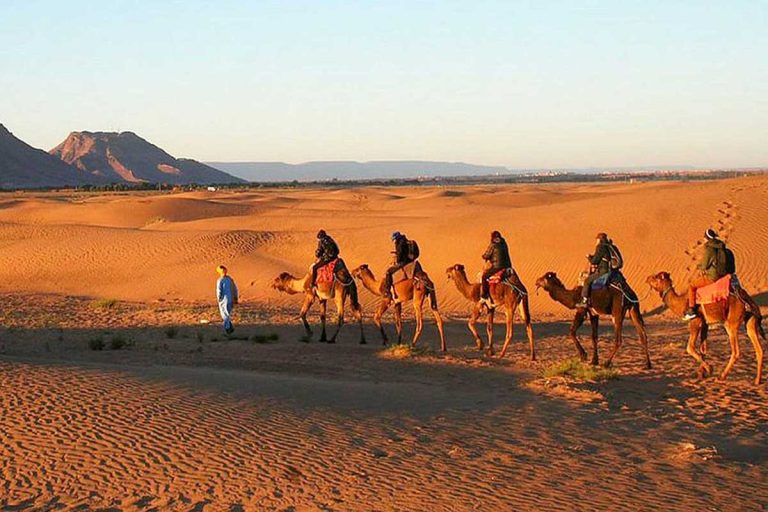
The 9-day Morocco tour from Rabat costs from €1350 per person — eight nights half-board in riads and guesthouses, your own vehicle and driver, and licensed local guides in Fes and Marrakech included, never a group. It is built on Morocco’s calmest entry point: Rabat’s airport has an empty arrivals hall, the capital deserves the full first day it gets (Chellah, the Udayas, Hassan Tower), and the loop then spends its strength where the north and coast excel — Chefchaouen, two full Fes days (one medieval, one artisan), Marrakech in depth, and an Essaouira night instead of an Essaouira glimpse, with Casablanca on the return. The honest trade: no Sahara. Travellers who need the dunes should compare the 10-day Imperial Cities & Sahara grand tour. The written quote, hotels named, arrives within the hour on WhatsApp.
| Duration | 9 Days |
| Price | From €1350 per person — car, driver and accommodation included |
| Departures | Your dates — every departure is private, never a shared group |
| Languages | English- and French-speaking driver-guides; licensed city guides where included |
| Booking | WhatsApp +212 661 454 738 — written quote within 1 hour, no payment at this stage |
Most grand tours treat Rabat as a drive-through; this one is built on it. Flying into the capital means an empty arrivals hall, a first night in a real city rather than a transit hub, and a loop that spends its nine days on what the north and the coast actually do best: two full days in Fes (one medieval, one artisan), Marrakech at full depth, and an Essaouira night instead of an Essaouira glimpse.
The honest trade-off: there is no Sahara here. The route chooses city depth and Atlantic air over two desert road days — travellers who want the dunes should look at our 10-day Imperial Cities & Sahara grand tour, which covers that ground from Casablanca.
- Start and end in Rabat, Morocco's understated capital
- Wander the blue-washed lanes of Chefchaouen
- A guided day and an artisan day in medieval Fes
- Jemaa el-Fna at full boil — Africa's busiest square
- Seafood and sunset on Essaouira's 18th-century ramparts
Itinerary
Open a day to see the detail: transport, accommodation, meals and activity time.
Day 1 Arrive in Rabat, the capital
Arrival in Rabat, imperial city and Morocco's current capital. The first afternoon belongs to its layered monuments: the Chellah necropolis where Roman and Islamic ruins share one walled garden, the white-and-blue lanes of the Kasbah of the Udayas, the Andalusian Gardens, and the pairing of Hassan Tower — a 12th-century minaret of a mosque never completed — with the Mausoleum of Mohammed V.
Day 2 North to Chefchaouen
The road climbs into the Rif, with an optional 2-3 hour hike to the Akchour waterfalls en route. Chefchaouen's medina has barely moved since the 15th century: Plaza Outa el-Hammam, craft shops, the Grand Mosque and the kasbah with its garden and museum. In the late afternoon, the 20-30 minute climb to the Spanish Mosque frames the blue city at sunset.

Day 3 Volubilis and Meknes, then Fes
South through the hills to Volubilis, the remarkably preserved Roman city founded in the 3rd century BC, then Meknes — the quieter imperial sibling with Bab al-Mansour, the mausoleum of Moulay Ismail and the vast underground Royal Stables. At dusk you stand at the Marinid Tombs above Fes as the medieval city lights come on. Riad evening below.

Day 4 Fes, day one: the medieval medina
A guided half-day through the most complete medina in the Arab world, from Bab Boujeloud down the Talâa Kebira artery: souks, Hispano-Moorish facades, the Chouara tannery and its 11th-century dye pits seen from a leather-shop roof, and the 14th-century Al Attarine madrasa with its zellige interior. The rest of the day is yours to get deliberately lost.

Day 5 Fes, day two: museums, mosaics and gardens
The Batha Museum — a 19th-century palace of carved wood, zellige and pottery with its own Andalusian garden — then the Mellah and its panorama over the Ville Nouvelle. At a ceramics cooperative you watch mosaic masters cut and set zellige by hand, before the day winds down through the fountains and lake of the Jnan Sbil gardens.
Day 6 The long road to Marrakech
The one honest transfer day of the trip, west then south to Marrakech — broken at your choice in Meknes, Rabat or Casablanca, or across the cedar country of the Middle Atlas. By evening you walk from Jemaa el-Fna to the floodlit Koutoubia and back into the square at full boil: musicians, storytellers, food stalls and mint tea above it all.

Day 7 Marrakech: the Red City
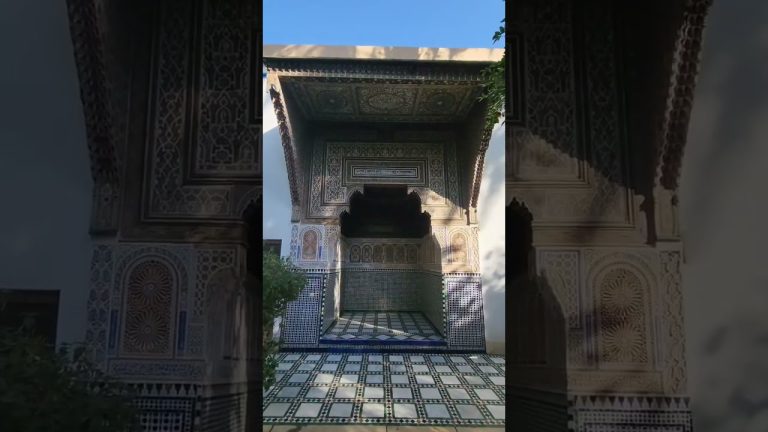
A day inside the millennium-old sandstone walls: the 12th-century Koutoubia and its gardens, the spice and slipper souks (el-Attarin, Smata), the carved-cedar Ben Youssef madrasa, and the medieval fondouks hiding in plain sight. South of the square, your pick of the Saadian Tombs, the sunken gardens of El Badi or the painted ceilings of the Bahia Palace.
Day 8 To the Atlantic: Essaouira
Through argan country — goats in the trees if luck allows, an argan-oil cooperative if you want the stop — to the wind-cooled port of Essaouira. The 18th-century Skala ramparts line up their bronze cannons against the Atlantic; the UNESCO medina, the beach and the fresh-fish grills do the rest. Jimi Hendrix pilgrims can detour to Diabat.
Day 9 Essaouira morning, Casablanca, back to Rabat
A last windy morning among the kitesurfers, then the coast road north with a Casablanca stop — the old medina for final souvenirs, the Corniche, and Rick's Café for film pilgrims. Drop-off in Rabat for your evening flight, or a final night in the capital.

Rabat is the quietest of Morocco's entry points — direct flights, an empty arrivals hall and a capital worth a day in its own right. This route trades the desert for depth in the cities and the Atlantic coast; if the Sahara is non-negotiable, our 10-day Imperial Cities & Desert grand tour is the sister itinerary. Day 6 is the long transfer (Fes to Marrakech); your driver breaks it wherever suits you.
Included in your tour
- Private air-conditioned vehicle with English/French-speaking driver-guide — 9 days
- Pickup at Rabat airport, train station or your hotel
- Night 1: riad in Rabat — half-board
- Night 2: guesthouse in Chefchaouen — half-board
- Nights 3-5: riad in the Fes medina — half-board
- Nights 6-7: riad in the Marrakech medina — half-board
- Night 8: riad in the Essaouira medina — half-board
- Guided days in Fes and Marrakech with licensed local guides
- Stops at Volubilis, Meknes and Casablanca
- Drop-off in Rabat (hotel, station or airport)
Not included
- International flights
- Lunches and beverages
- Entrance fees to monuments and historical sites (optional — pay directly)
- Tips for guide and driver
- Personal expenses
- Travel insurance (recommended)
Explore more
Historical sites Marrakech Fes Chefchaouen Essaouira Casablanca
Questions travellers ask
How much does Morocco Tour from Rabat – 9 Days: Imperial Cities & Coastal Towns cost?+
From €1350 per person, per person. The price includes private air-conditioned vehicle with english/french-speaking driver-guide — 9 days, pickup at rabat airport, train station or your hotel, night 1: riad in rabat — half-board. You receive a written itemised quote before paying anything — no hidden fees.
How long is this tour and when does it depart?+
9 Days, departing on the dates you choose — there is no fixed schedule, because every departure is arranged for you alone.
Is this a group tour or private?+
Fully private: your own vehicle, driver and licensed guide, never seat-in-coach and never mixed with other travellers. The daily pace flexes around you.
How long does it take to get from Marrakech to Fes?+
Around 530 km: 5 to 6 hours by road across the Middle Atlas, or about 7 hours by train via Casablanca. The scenic answer is to not go direct at all — our 4-day desert crossings link the two cities through Merzouga, turning the transfer into the trip's highlight.
How do you navigate the Fes medina?+
Accept that you will be pleasantly lost, then use the system: the two main arteries (Talaa Kebira and Talaa Sghira) run downhill through the medina, downhill generally leads toward the river and the tanneries, and blue Bab Boujeloud is the compass point. Take a licensed guide the first day — the maze reads like a map afterwards.
Is Fes worth visiting?+
For history, unreservedly: it is the oldest imperial city, home to Al-Qarawiyyin — regarded as the world's oldest continuously operating university — the finest carved madrasas in the country and the famous tanneries. Give it a full guided day plus an evening on the rooftops.
How old is the Fes medina?+
Founded in 789 by Idriss I and built into a capital by his son from 809, Fes el-Bali is over 1,200 years old — and continuously inhabited the entire time, which is the real marvel. Al-Qarawiyyin, teaching since 859, is routinely cited as the world's oldest existing university. When you press against a wall to let a donkey pass, that scene has been running unchanged for a millennium.
More answers in the “Fes” chapter of our Travel FAQ →
Itinerary and prices last updated October 2026.