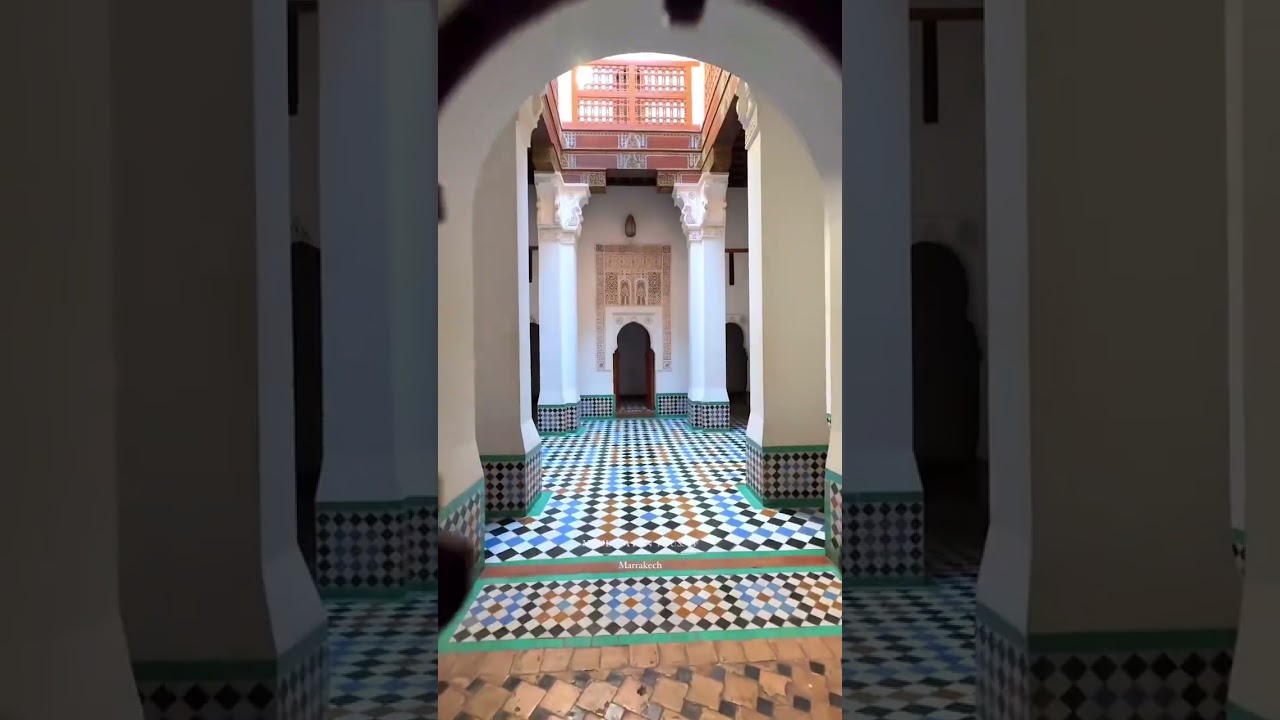
For four centuries the Ben Youssef Madrasa was the Harvard of the western Islamic world: Morocco’s largest Koranic college, housing up to 900 students in 130 cells stacked around one of the most photographed courtyards in Africa. Founded in the 14th century under the Merinids and rebuilt in the 1560s by Saadian sultan Abdallah al-Ghalib, it reopened after meticulous restoration and looks the best it has in living memory.
The courtyard is the headline — a reflecting pool, walls that graduate from zellij to stucco to cedar as they rise, and the prayer-hall’s mihrab framed in carved calligraphy. But climb to the student cells: the contrast between the ornate court and those bare, monkish rooms tells you what scholarly life actually was. The light shafts in the upper corridors are a photographer’s reward.
Thirty to forty-five minutes does it justice; go at opening or near closing to have the courtyard’s reflection to yourself. It sits in the medina’s north beside the Almoravid Koubba and the Marrakech Museum — the scholarly quarter our guided medina mornings thread together.
Key facts
- Morocco's largest madrasa — up to 900 students in 130 cells
- Rebuilt 1560s under Saadian sultan Abdallah al-Ghalib
- Recently restored; the courtyard is the icon
- Allow 30–45 minutes; opening time is quietest
- Entry ticket paid on site (around 50 MAD historically — check current)
Good to know
The famous courtyard shot needs patience or an early start. Combine with the Almoravid Koubba next door — Marrakech's oldest surviving building — for the full scholarly quarter.
Questions travellers ask
Is Marrakech worth visiting?+
Yes — with the right expectations. It delivers spectacle like nowhere else in Morocco: Jemaa el-Fna at dusk, the souk labyrinth, palaces and gardens, the Atlas an hour away. It is also intense: touts, heat and noise are part of the package. Two to three days is the sweet spot, ideally as the gateway to the mountains or the desert rather than the whole trip.
Can you wear shorts in Marrakech?+
You can — tourists do, and knee-length shorts raise no issues in the main areas. That said, light long trousers or skirts are both cooler in the sun and more comfortable deep in the medina, where dress runs conservative. For mosque visits and rural villages, covered knees and shoulders are the respectful standard.
What is Marrakech famous for?+
Jemaa el-Fna square and its nightly food-stall theatre, the souks, the Koutoubia minaret, the Bahia Palace and Saadian Tombs, the Majorelle and Menara gardens — and its role as the classic base for the High Atlas, Essaouira and the desert routes south.
What is Marrakech known for?+
The Red City is Morocco's sensory capital: Jemaa el-Fna square and its nightly food theatre, the labyrinth of souks, palaces like the Bahia, the Koutoubia minaret, the Majorelle Garden — and its role as gateway to the Atlas mountains and the Sahara routes. It is also Africa's events capital, hosting everything from film festivals to GITEX. Most Morocco journeys start, end or pivot here — ours have since 2011.
More answers in the “Marrakech” chapter of our Travel FAQ →