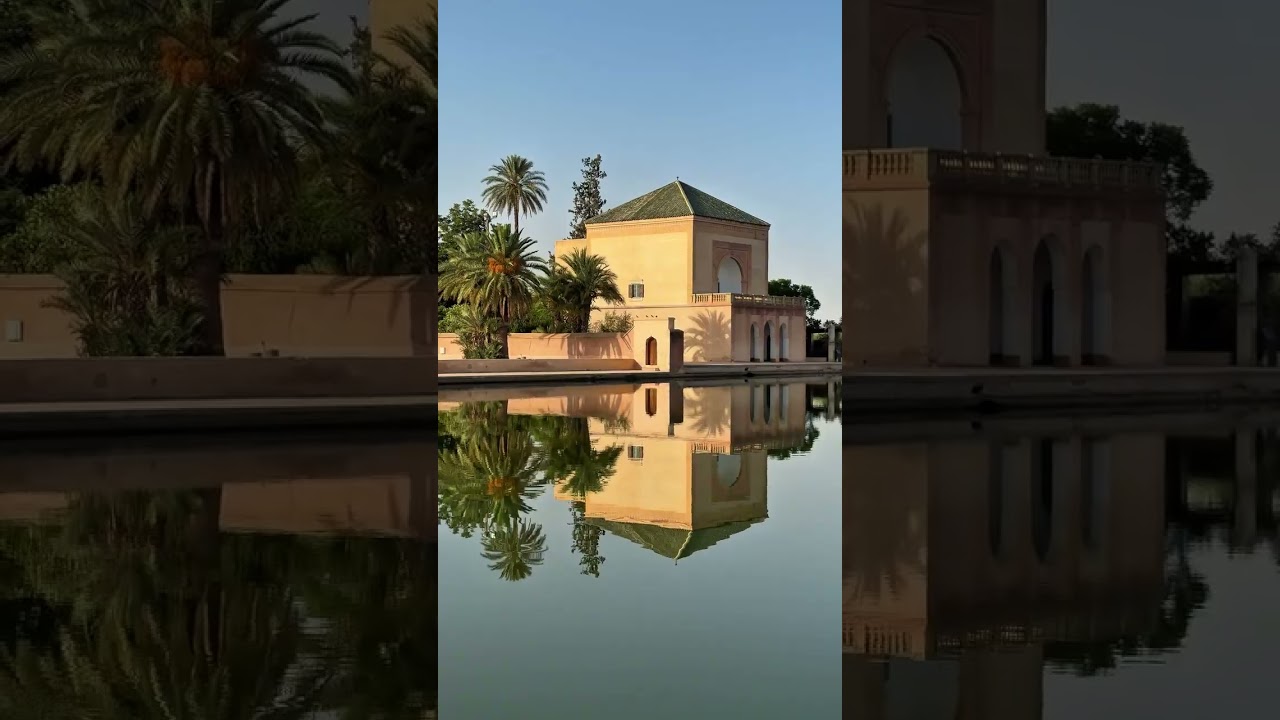
The Menara is Marrakech’s oldest calm: a great reflecting basin dug by the Almohads in the 12th century to water a hundred hectares of olive groves, fed by khettara channels from the Atlas — engineering that still functions nine centuries on. The green-tiled pavilion beside the water, a 19th-century addition, completes one of Morocco’s most reproduced images: pavilion, palms and snow-capped Atlas in one frame.
Come for atmosphere rather than attractions: locals jogging the olive rows at dawn, families picnicking at dusk, carp roiling the basin. On clear winter and spring days the mountain backdrop turns the postcard real — photographers should aim for first light (the birdlife is another quiet reward, detailed here).
Thirty minutes suffices, and the gardens sit conveniently on the airport side of town — our drivers often slot the Menara as a soft first stop after landing or a last breath of green before a flight. Garden access has historically been free, with a small fee for the pavilion when open; check on the day.
Key facts
- Basin and olive groves laid out by the Almohads (12th century)
- Fed by khettara channels from the Atlas — still working
- Pavilion added in the 19th century; the classic Atlas-reflection shot
- Best light: dawn and late afternoon
- Allow ~30 minutes; garden entry historically free
Good to know
The famous reflection needs still air — mornings win. It is a working orchard and a local park more than a 'sight': come for the calm, not a checklist.
Questions travellers ask
Is Marrakech worth visiting?+
Yes — with the right expectations. It delivers spectacle like nowhere else in Morocco: Jemaa el-Fna at dusk, the souk labyrinth, palaces and gardens, the Atlas an hour away. It is also intense: touts, heat and noise are part of the package. Two to three days is the sweet spot, ideally as the gateway to the mountains or the desert rather than the whole trip.
Can you wear shorts in Marrakech?+
You can — tourists do, and knee-length shorts raise no issues in the main areas. That said, light long trousers or skirts are both cooler in the sun and more comfortable deep in the medina, where dress runs conservative. For mosque visits and rural villages, covered knees and shoulders are the respectful standard.
What is Marrakech famous for?+
Jemaa el-Fna square and its nightly food-stall theatre, the souks, the Koutoubia minaret, the Bahia Palace and Saadian Tombs, the Majorelle and Menara gardens — and its role as the classic base for the High Atlas, Essaouira and the desert routes south.
What is Marrakech known for?+
The Red City is Morocco's sensory capital: Jemaa el-Fna square and its nightly food theatre, the labyrinth of souks, palaces like the Bahia, the Koutoubia minaret, the Majorelle Garden — and its role as gateway to the Atlas mountains and the Sahara routes. It is also Africa's events capital, hosting everything from film festivals to GITEX. Most Morocco journeys start, end or pivot here — ours have since 2011.
More answers in the “Marrakech” chapter of our Travel FAQ →