Morocco in Depth: Imperial Cities Tour – 15 Days
- Private vehicle & driver — Pick-up at your riad, pace set by you
- Local licensed guide — Licensed guide nº2898 · since 2011
- Book on WhatsApp — Reply within 1 hour · no payment at this stage
- All four imperial capitals with real guided hours in each
- Guerrouane winery day plus a Fes baking class and food tour
- One Erg Chebbi camp night as the route's intermission


A private 15-day tour from Casablanca: from €2250 per person, with vehicle, driver, licensed guide and accommodation included — no groups, departures on your dates. Along the way: Rabat, Chefchaouen and Fes.
| Duration | 15 Days |
| Price | From €2250 per person — car, driver and accommodation included |
| Departures | Your dates — every departure is private, never a shared group |
| Languages | English- and French-speaking driver-guides; licensed city guides where included |
| Booking | WhatsApp +212 661 454 738 — written quote within 1 hour, no payment at this stage |
Fifteen days built around the imperial idea — four royal capitals given full measure, with the Sahara as intermission rather than headline. Casablanca and Rabat open with their monuments; Chefchaouen and Fes carry the middle, including a winery day and a baking-class-plus-food-tour that turn history into flavour; then the desert crossing, a guided Marrakech, and a wellness finale — sunrise yoga, hammam, a dawn balloon — before the Portuguese coast leads home.
This is the culture-forward cut of the grand loop: more guided hours in the medinas, more hands-on sessions, and a gentler back half where the body gets equal billing with the monuments. It suits travellers who want the classics annotated rather than merely visited.
Private vehicle and driver-guide throughout; licensed guides in every medina; ensuite camp at the erg.
Fifteen days for travellers who want the imperial cities properly, from €2250 per person: Casablanca and the Hassan II Mosque, Rabat with Salé across the river, Chefchaouen, Volubilis and Moulay Idriss, then real depth in Fes — the medina, the Guerrouane winery, a baking class and a food tour — before Merzouga’s dunes and the Tichka road to a guided Marrakech.
Where our other 15-day routes spread the days across regions, this one banks them in the cities: two and three nights at a time, with the desert as a two-day interlude rather than the headline. The baking class and food tour are included, not add-ons.
History-minded travellers and returning visitors who rushed Fes the first time choose this route. Private throughout, on your dates — WhatsApp us and the full quote comes back within the hour.
Depth, not distance: this fifteen-day imperial route spends its extra time inside the cities rather than between them — a baking class and food tour in Fes, the Guerrouane vineyard, sunrise yoga and a hammam in Marrakech, the balloon morning — and still carries you through Merzouga’s dunes on the way south. It is the itinerary for travellers who would rather know four cities well than photograph eight briefly.
- All four imperial capitals with real guided hours in each
- Guerrouane winery day plus a Fes baking class and food tour
- One Erg Chebbi camp night as the route's intermission
- Sunrise yoga, hammam and a dawn balloon in Marrakech
- El Jadida's Portuguese cistern on the coastal return
Photos from the tour




Itinerary
Open a day to see the detail: transport, accommodation, meals and activity time.
Day 1 Casablanca and the Hassan II Mosque
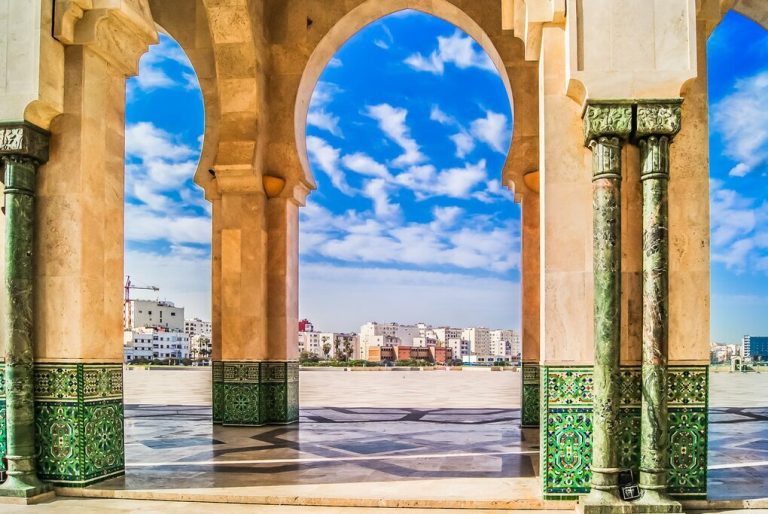
The empire theme opens at its newest monument: the Hassan II Mosque, guided, inside — a 20th-century addition worthy of its royal ancestors, the Atlantic under the glass floor, the minaret navigable from half the city. The Corniche takes the evening: ocean air, art-deco silhouettes, a seafood table that knows its trade.

Day 2 Rabat: the capital and Salé
The current capital in full: Rabat's Hassan Tower and the mausoleum's virtuoso zellige, the Oudayas' blue kasbah with its Andalusian garden — then across the river to Salé, the corsair twin most itineraries skip, for its medersa and unhurried lanes. Two royal cities, one afternoon, and a fraction of the visitors either deserves.

Day 3 Chefchaouen
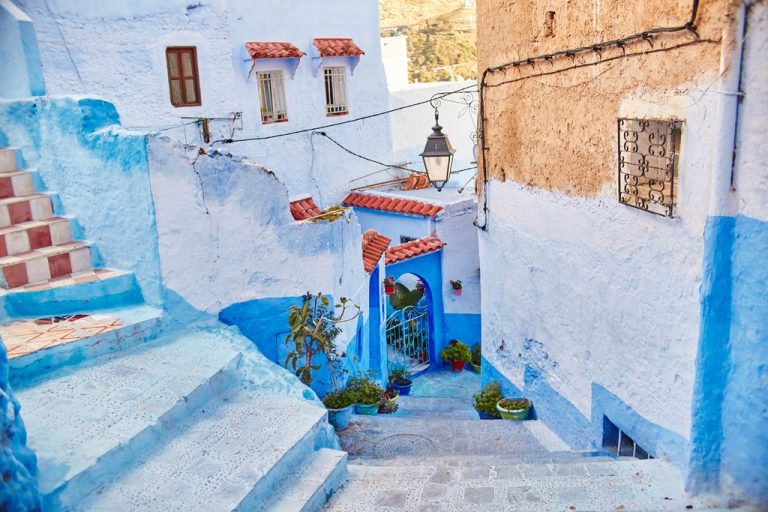
North to the mountain interlude: the Rif road through Ouazzane's olive country delivers Chefchaouen by late afternoon, blue at its bluest exactly then. The evening is free in the lanes — the kasbah square for dinner, the Spanish Mosque viewpoint for those who chase last light up a hillside.

Day 4 Volubilis — Moulay Idriss — Meknes — Fes
The royal road south, dense with foundations: Volubilis' Roman mosaics open to the sky, Moulay Idriss white on its two sacred hills, Meknes and Bab Mansour — the whole grammar of how power moved through this land — arriving in Fes by evening for a three-night residence inside the walls.

Day 5 Fes, the imperial city
Fes, guided from gate to tannery: Bab Boujeloud's blue, the Bou Inania's carved cedar, Al-Qarawiyyin's doorways — founded 859, still teaching — the coppersmiths' concert and the guild quarters at work. The imperial city as a living syllabus, taken at strolling pace with rooftop punctuation.

Day 6 The Guerrouane winery
A vineyard day from Fes: the Guerrouane appellation's cellars and rows near Meknes, where vines have grown since the Romans planted them — cellar tour, barrel talk, and a long tasting lunch between the rows. The empire's most cheerful continuity, and the route's most unexpected chapter.

Day 7 Baking class and food tour
Fes hands-on: a morning baking class at a neighbourhood oven — bread kneaded, msemen folded, the pastries every family debates — then an afternoon food tour through the stalls locals defend fiercely: harira, snail broth for the brave, the sweet windows. History you can taste, in the city that considers itself Morocco's kitchen.
Day 8 Over the Middle Atlas to Merzouga
The intermission begins: over the Middle Atlas — Ifrane's chalets, cedar forests with macaques on inspection duty, Midelt's plain under Jbel Ayachi — and down the Ziz gorges' palm river to Merzouga, where camels take the golden hour into the Erg Chebbi. Camp: ensuite tents, lantern dinner, drums, stars in dynastic quantities.

Day 9 Merzouga — Ouarzazate
Dune sunrise from the crest, then the westward sweep at desert pace: Erfoud's fossil ateliers polishing ancient sea floors, the Todra Gorge's canyon-floor walk between 300-metre walls, and the kasbah road into Ouarzazate for the night — the desert chapter closed with its best pages read aloud.

Day 10 The Tizi n'Tichka to Marrakech
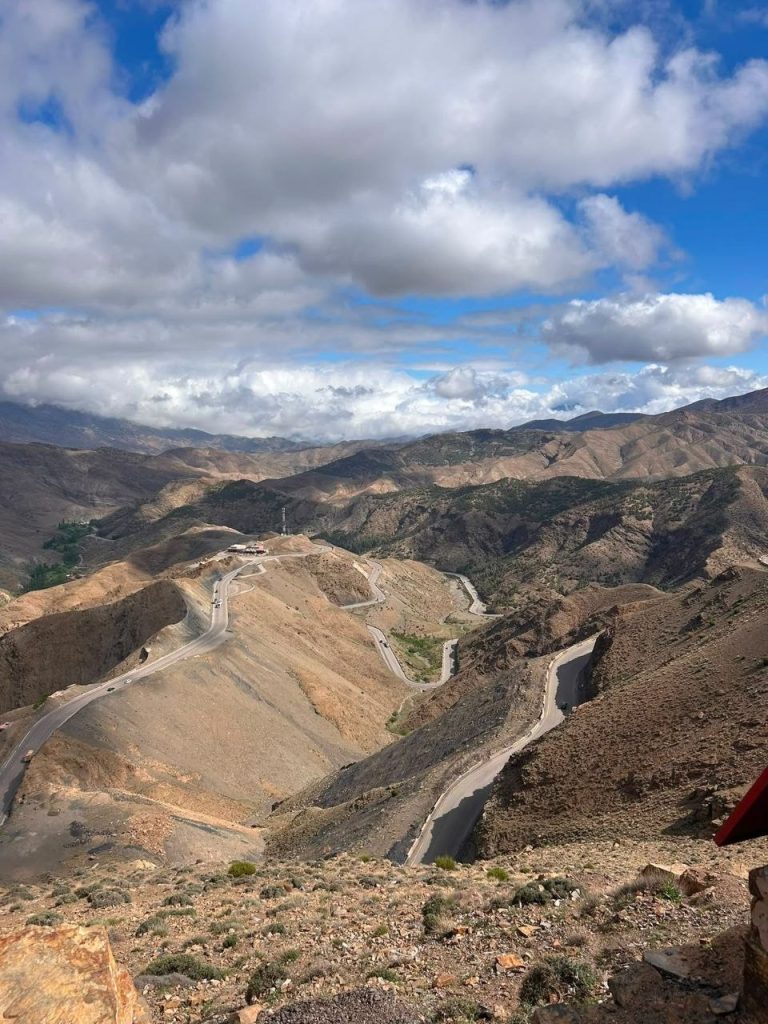
Aït Ben Haddou climbed to the granary in morning quiet — the UNESCO ksar's earthen lanes to yourself before the buses — then the Tizi n'Tichka's mint-tea descent, 2,260 metres unwinding into the plain, and Marrakech, the fourth capital, receiving you by evening. Jemaa el-Fna performs; you spectate from a rooftop.
Day 11 Marrakech, guided
Marrakech guided: the Bahia's ceilings, the Saadian Tombs' chamber of twelve columns, the Koutoubia gardens, and the souks decoded until they become a pleasure — the southern capital's full argument, made in one confident day with a licensed guide doing the footnotes.

Day 12 Sunrise yoga and hammam
The body's turn in the empire of the senses: sunrise yoga on a quiet rooftop as the swifts wake, a long hammam ritual at midday — steam, black soap, the kessa glove, rose water — and an afternoon of licensed idleness by the pool or in the courtyard. Monuments can wait; this is also Morocco.

Day 13 Balloon morning
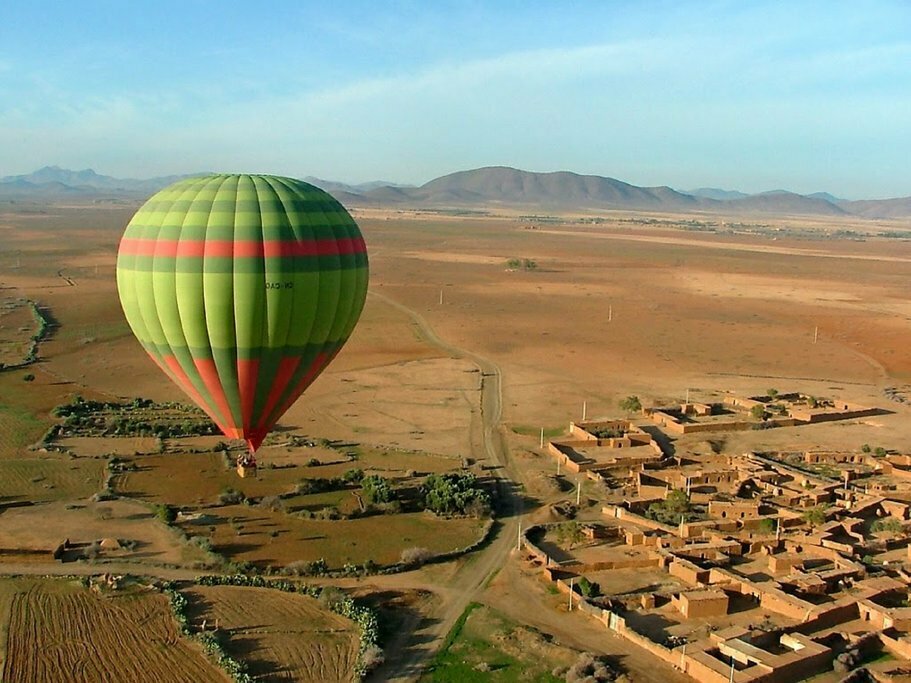
The balloon takes the dawn: lift-off over the palmery, the Atlas silvering at the horizon, breakfast on landing with the pilots. The rest of the day is free for whatever Marrakech still owes you — Majorelle, one last atelier commission, a farewell rooftop with the Koutoubia framed just so.

Day 14 The Portuguese coast to Casablanca
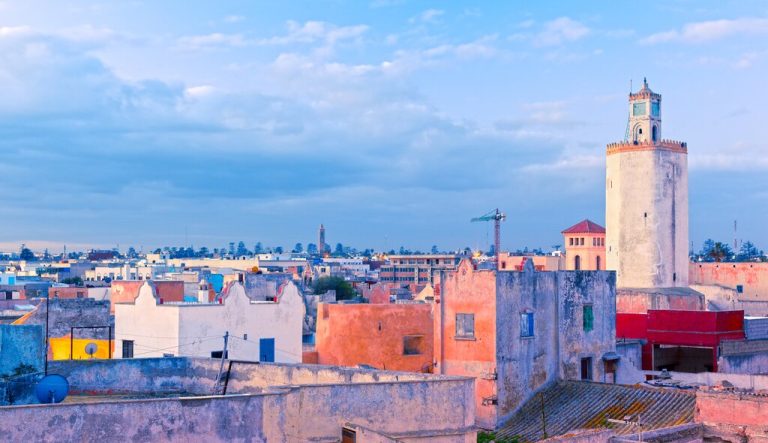
The coastal route home through Portugal's Moroccan chapter: El Jadida's fortress city and its famous cistern — light shafting onto the water floor exactly as the photographs promise — then Casablanca by evening for a final Atlantic dinner where the route began its story.
Day 15 Departure
Departure from Casablanca: fifteen days, four capitals given full measure, one desert intermission, two crafts learned by hand — an empire's worth of context, packed for the flight home.
The wellness sessions (yoga, hammam, balloon) are woven in, not bolted on — tell us your preferences and we tune intensity. Book the balloon-window days with flexibility; dawn flights depend on wind. October–May is the route's best season.
Included in your tour
- Private air-conditioned 4×4 or minivan with English/French-speaking driver-guide — 15 days
- Pickup at Casablanca airport or your hotel
- Night 1: Casablanca hotel — half-board
- Night 2: Rabat riad — half-board
- Night 3: Chefchaouen riad — half-board
- Nights 4–5: Fes riad (2 nights) — half-board
- Night 6: Meknes riad — half-board
- Night 7: Fes riad — half-board
- Night 8: luxury ensuite desert camp — half-board
- Night 9: kasbah hotel, Ouarzazate — half-board
- Nights 10–13: Marrakech riad (4 nights) — half-board
- Night 14: Casablanca hotel — half-board
- Guided visit of Fes with a licensed local guide (Day 5)
- Guided visit of Marrakech with a licensed local guide (Day 11)
- Guided visit of Casablanca with a licensed local guide (Day 1)
- Guided visit inside the Hassan II Mosque, Casablanca
- Guided visit of the Aït Ben Haddou ksar (UNESCO)
- Camel trek in the dunes
- Sunrise hot-air balloon flight over the palmery
- Traditional hammam session
- Guided food tour
- Drop-off at your Casablanca hotel or at the airport
Not included
- International flights
- Lunches and beverages
- Entrance fees to monuments and historical sites (optional — pay directly)
- Tips for guide and driver
- Personal expenses
- Travel insurance (recommended)
Explore more
Historical sites Marrakech Merzouga & the Sahara High Atlas Fes Chefchaouen
Questions travellers ask
How much does Morocco in Depth: Imperial Cities Tour – 15 Days cost?+
From €2250 per person, per person. The price includes private air-conditioned 4×4 or minivan with english/french-speaking driver-guide — 15 days, pickup at casablanca airport or your hotel, night 1: casablanca hotel — half-board. You receive a written itemised quote before paying anything — no hidden fees.
How long is this tour and when does it depart?+
15 Days, departing on the dates you choose — there is no fixed schedule, because every departure is arranged for you alone.
Is this a group tour or private?+
Fully private: your own vehicle, driver and licensed guide, never seat-in-coach and never mixed with other travellers. The daily pace flexes around you.
How long does it take to get from Marrakech to Fes?+
Around 530 km: 5 to 6 hours by road across the Middle Atlas, or about 7 hours by train via Casablanca. The scenic answer is to not go direct at all — our 4-day desert crossings link the two cities through Merzouga, turning the transfer into the trip's highlight.
How do you navigate the Fes medina?+
Accept that you will be pleasantly lost, then use the system: the two main arteries (Talaa Kebira and Talaa Sghira) run downhill through the medina, downhill generally leads toward the river and the tanneries, and blue Bab Boujeloud is the compass point. Take a licensed guide the first day — the maze reads like a map afterwards.
Is Fes worth visiting?+
For history, unreservedly: it is the oldest imperial city, home to Al-Qarawiyyin — regarded as the world's oldest continuously operating university — the finest carved madrasas in the country and the famous tanneries. Give it a full guided day plus an evening on the rooftops.
How old is the Fes medina?+
Founded in 789 by Idriss I and built into a capital by his son from 809, Fes el-Bali is over 1,200 years old — and continuously inhabited the entire time, which is the real marvel. Al-Qarawiyyin, teaching since 859, is routinely cited as the world's oldest existing university. When you press against a wall to let a donkey pass, that scene has been running unchanged for a millennium.
More answers in the “Fes” chapter of our Travel FAQ →
Itinerary and prices last updated October 2026.