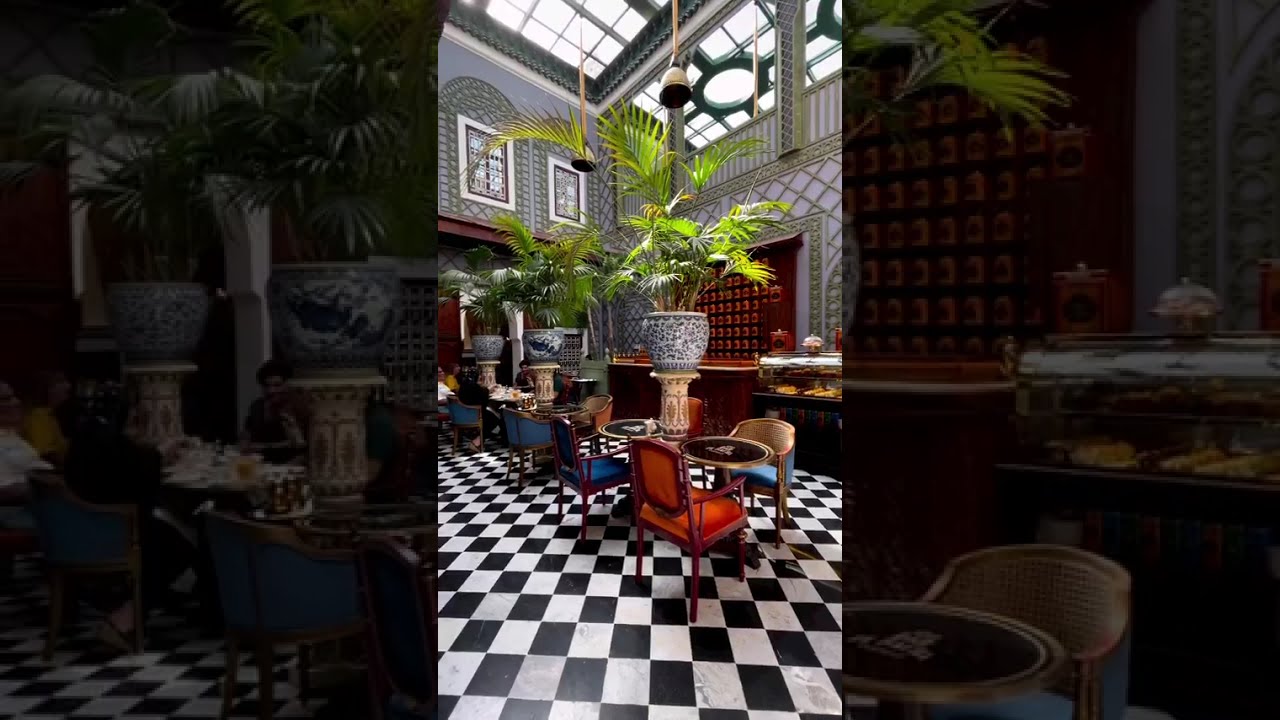
Dar el Bacha — the House of the Pasha — belonged to Thami El Glaoui, the ‘Lord of the Atlas’ who ruled southern Morocco for the first half of the 20th century and entertained everyone from Churchill onward under these cedar ceilings. It is the last great palace of the classic tradition, and its riad courtyard — orange trees, fountain, candy-striped arches — is among the city’s most beautiful rooms.
Today it houses the Musée des Confluences, whose rotating exhibitions pair Moroccan craft with international collections — but many visitors come as much for the celebrated coffee house installed in the former kitchens, where single-origin coffees are served with palace-era theatre. Booking ahead for the café is wise in season.
Count 45 minutes for palace and exhibition, more if the café tempts you. It sits on the Dar el Bacha artery at the medina’s north-west, minutes from the souks — an easy pairing with the Ben Youssef quarter on a guided morning. The deeper history is told in our Dar el Bacha story.
Key facts
- Palace of Thami El Glaoui, Pasha of Marrakech (early 20th c.)
- Now the Musée des Confluences — rotating exhibitions
- Home to a famously theatrical coffee house
- Allow ~45 minutes (plus café time)
- Closed some Mondays historically — check before going
Good to know
The café queue can outgrow the museum's — reserve or go at opening. Photography is generous in the courtyards, restricted in some exhibition rooms.
Questions travellers ask
Is Marrakech worth visiting?+
Yes — with the right expectations. It delivers spectacle like nowhere else in Morocco: Jemaa el-Fna at dusk, the souk labyrinth, palaces and gardens, the Atlas an hour away. It is also intense: touts, heat and noise are part of the package. Two to three days is the sweet spot, ideally as the gateway to the mountains or the desert rather than the whole trip.
Can you wear shorts in Marrakech?+
You can — tourists do, and knee-length shorts raise no issues in the main areas. That said, light long trousers or skirts are both cooler in the sun and more comfortable deep in the medina, where dress runs conservative. For mosque visits and rural villages, covered knees and shoulders are the respectful standard.
What is Marrakech famous for?+
Jemaa el-Fna square and its nightly food-stall theatre, the souks, the Koutoubia minaret, the Bahia Palace and Saadian Tombs, the Majorelle and Menara gardens — and its role as the classic base for the High Atlas, Essaouira and the desert routes south.
What is Marrakech known for?+
The Red City is Morocco's sensory capital: Jemaa el-Fna square and its nightly food theatre, the labyrinth of souks, palaces like the Bahia, the Koutoubia minaret, the Majorelle Garden — and its role as gateway to the Atlas mountains and the Sahara routes. It is also Africa's events capital, hosting everything from film festivals to GITEX. Most Morocco journeys start, end or pivot here — ours have since 2011.
More answers in the “Marrakech” chapter of our Travel FAQ →