★★★★★ Rated 4.5/5 — 204 Google reviews · 576 reviews · 5.0/5 on Tripadvisor · Written by a licensed Marrakech tour operator, on the road since 2011
Marrakech runs a double economy — one priced for local life, one for whoever looks newly landed. Your trip’s cost depends almost entirely on which one you shop in. Here is the honest ledger.
The cheap column
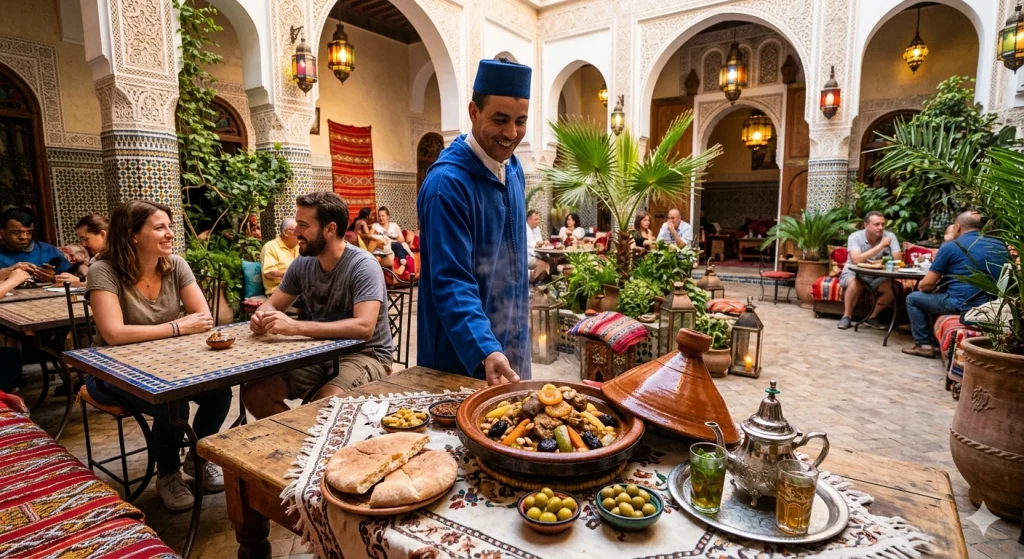
Street food and local cafés: a filling tagine or bowl of harira for a few euros; fresh orange juice on the square for less than a coffee costs at home. Petit taxis across town: pocket change when the meter runs. Monument entries: most major sites charge modest flat fees — a full sightseeing day rarely passes €25 in tickets. Mint tea: effectively free with everything.
The flexible column
Riads span €40 to €400 a night for rooms that can look identical online — the difference is location, service and breakfast honesty. Restaurant mains run European prices in the guidebook spots and half that two lanes away. Souvenirs cost whatever your haggling says they cost.

The premium column
Rooftop dinner-shows, spa hammams, golf, the famous gardens’ skip-the-line tours — Marrakech happily absorbs luxury budgets. None of it is obligatory; all of it is well done if you want it.
Real prices you’ll pay in 2026
Numbers beat adjectives, so here is what things typically cost. Getting around: the airport-to-medina taxi runs about 70–100 dirhams (€7–10); a petit taxi across town on the meter is usually 20–50 dirhams. Eating: street food — msemen, harira, a bowl of snails — costs 5–30 dirhams; a tagine in a locals’ restaurant 40–80 dirhams; dinner in a tourist-district rooftop 150–350 dirhams per person. Sleeping: clean budget riads sit around €25–50 a night for a double, stylish mid-range ones €60–150, and the palace hotels start where those end. Seeing: most monuments charge foreigners around 70–100 dirhams; Jardin Majorelle is the outlier at roughly 170 dirhams booked online. A neighbourhood hammam costs about 50 dirhams; the candle-lit spa version of the same ritual, 300–600.
Where budgets actually leak
Not on the tagines — on the unplanned extras: the “free” henna that isn’t, the monkey photo with a price tag, the unofficial guide who materialises at the tannery door, the taxi that “has no meter today”. None of it is dangerous, all of it is avoidable, and we keep the complete list updated in our tourist-scams guide. Know the five classics and Marrakech gets noticeably cheaper.
Cheap here, expensive there
Genuinely cheap: food, city transport, hammams, oranges by the kilo. Genuinely not: alcohol (taxed and licensed), top-end riads in high season, and quality rugs — though the last one is negotiable by design.
What a day actually totals
Comfortable mid-range — riad, one nice dinner, entries, taxis — lands around €80–120 per person per day; backpacker versions manage half. Our own arithmetic is public: private touring from €150 per person per day including car, driver, guide and hotels — the premium buys the city with the friction removed. Budget detail lives in the budget FAQ.
To go deeper on single lines of this budget: the currency Morocco uses, tipping in Morocco, and — for the souk haggling itself — the Hand of Fatima, the souvenir everyone ends up pricing. Food-lovers can turn the budget into a Moroccan food & drink tour instead.
Everything on this page can be woven into a private itinerary — start from Morocco city breaks or book the 7-day Imperial Cities circuit, and we shape the rest around you.
Youssef El Amrani — Youssef grew up a few streets from Bab Doukkala and has watched Marrakech reinvent itself several times over without ever quite changing. He covers the city for our guides — the palaces and museums, yes, but mostly the practical texture of it: which gate to enter the souks by, when Jemaa el-Fna is worth your evening, how much a taxi should actually cost. His rule for every piece he writes: if a reader follows it on foot, it has to work.