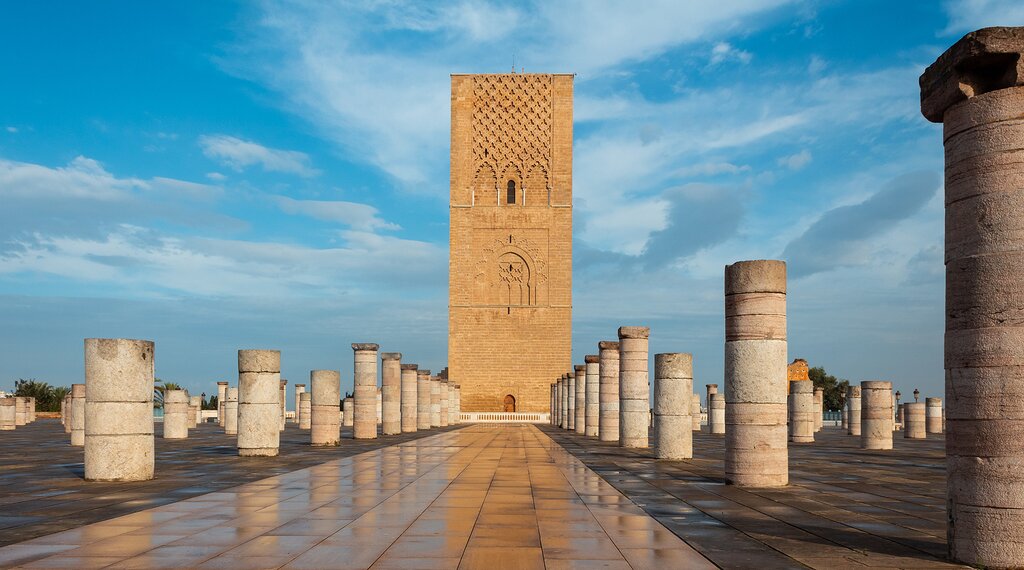
In 1195 the Almohad sultan Yacoub al-Mansour began what was planned as the largest mosque on earth; his death four years later froze the site forever at its most poetic: the Hassan Tower, a 44-metre minaret stopped mid-ascent, standing over a field of broken columns like a stone orchard. Eight centuries of wind have only improved the composition.
Across the esplanade rises its modern companion: the Mausoleum of Mohammed V, completed in 1971, where the king who led Morocco to independence lies with his sons — Hassan II among them — under a ceiling of gilded cedar, guarded by royal cavalry in red. Non-Muslim visitors may enter the gallery and look down on the tombs: one of the few royal interiors in the kingdom open to everyone, and free.
Give the pair 45 minutes, ideally late afternoon when the tower goes amber and the Bou Regreg glitters below. It stands ten minutes from the Udayas and Chellah — Rabat’s three great sites make one unhurried half-day on our four-cities circuit (from €750/person).
Key facts
- Minaret begun 1195, never finished — 44 m of the planned tower
- Field of columns from the unbuilt great mosque
- Mausoleum of Mohammed V (1971): royal tombs open to all visitors
- Royal guard in ceremonial dress at the gates
- Free entry; allow ~45 minutes
Good to know
The mausoleum gallery is open to non-Muslims — modest dress and quiet respect are the only tickets. Late afternoon light is the photographer's window.
Questions travellers ask
What is the Hassan II Mosque made of?+
Almost entirely of Morocco itself: granite and marble from Agadir and Tafraout, cedar from the Middle Atlas for the carved ceilings, zellij cut by thousands of maalems — with Murano glass chandeliers as the famous exception. Built 1986–1993 by some 10,000 craftsmen, its prayer hall floats half over the Atlantic on reclaimed land, with a retractable roof and a 210 m minaret.
What time does the Hassan II Mosque open for visits?+
Non-Muslim visitors enter on guided tours at fixed time slots outside prayer hours — historically several slots each morning and early afternoon, reduced on Fridays and adjusted during Ramadan. Slots shift with the religious calendar, so the golden rule is to check that day's schedule (or ask us the day before — we confirm locally). The exterior esplanade is open at all hours and free.
What is the Hassan II Mosque known for?+
Superlatives with substance: one of the world's largest mosques, its 210-metre minaret long the world's tallest, its prayer hall built half over the Atlantic with a retractable roof — and, most importantly for travellers, one of the very few working mosques in Morocco that non-Muslims can enter, on guided tours. It compresses every Moroccan craft — zellij, carved cedar, stucco — at cathedral scale.
Is Casablanca worth visiting, honestly?+
As a working metropolis it is not a postcard — but the Hassan II Mosque alone justifies the stop, and the art-deco centre and corniche reward a curious half-day. Most of our routes give it exactly that: arrival, the mosque, one good dinner.
More answers in the “Casablanca & Rabat” chapter of our Travel FAQ →