Home /Monuments of Morocco /Skoura
Monuments of Morocco

Kasbah Amridil, Skoura

Skoura · Monument guide

★★★★★ Rated 4.5/5 — 204 Google reviews · 576 reviews · 5.0/5 on Tripadvisor · Visiting notes updated October 2026

  • Visited on our private tours — Your own licensed city guide
  • Real visiting notes — Hours, tickets and the quiet hours
  • Plan it on WhatsApp — Reply within 1 hour
  • The most celebrated kasbah of the Skoura oasis — 17th-century origins
  • Once printed on the 50-dirham note
  • Living museum: olive press, bread ovens, clever mud engineering
Kasbah Amridil, Skoura
Reply within 1 hour · no payment at this stage
Private departures only — never in a group

Of the thousand kasbahs on the road east of Ouarzazate, Amridil is the one Morocco chose for its banknotes: the great fortified house of the Skoura oasis, four corner towers of sculpted mud rising from a sea of palms, seventeenth-century in origin and continuously loved since — the portrait kasbah of the whole southern tradition.

It earns the fame by remaining alive. The Nasiri family, its historic custodians, run it as a living museum: their tour (folded into the modest entry, ~50 MAD) works the olive press, fires the domed bread ovens, demonstrates the palm-trunk locks and the ingenious mud-and-reed cooling that made these towers habitable through desert summers. This is kasbah life explained by people whose grandparents lived it, not laminated panels.

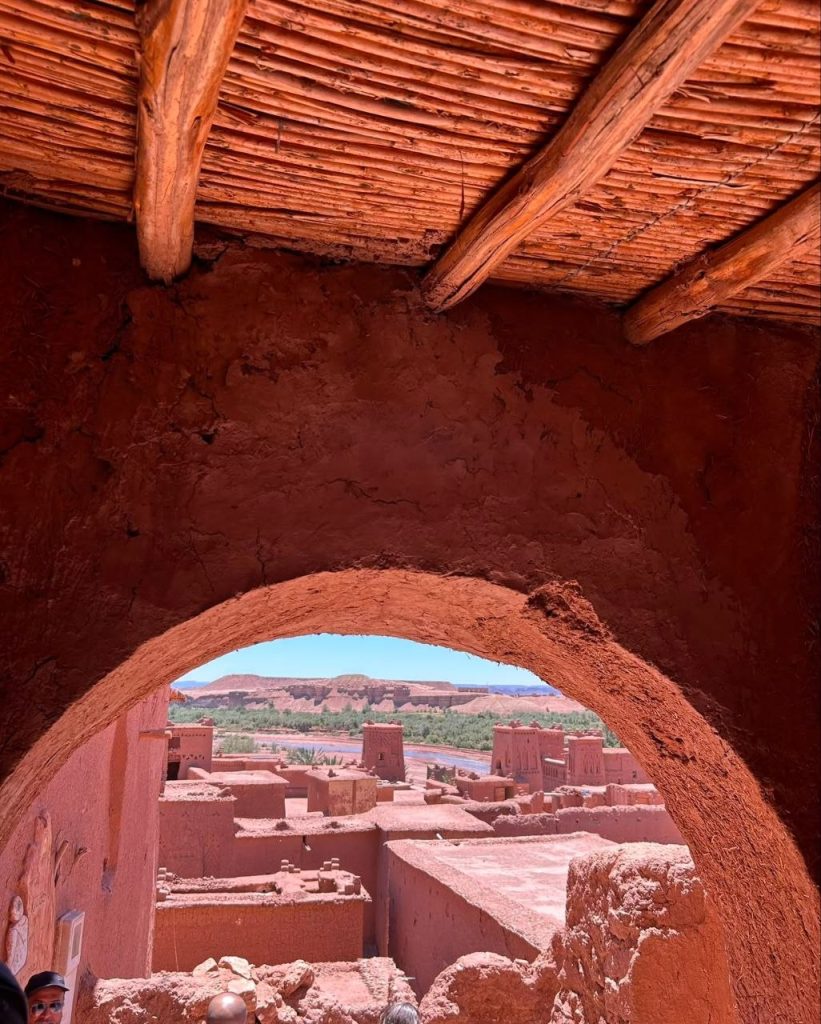
Architecture students of any level get the full grammar: pisé walls tapering skyward, corner towers crowned with the stepped merlons of the south, geometric incisions protecting the upper bands — decoration as weatherproofing — and interior courts stacking storerooms, kitchens, guest rooms and roof terraces in vertical village logic.

Around it breathes Skoura, the palm grove that shames its famous neighbours by staying real: a million palms shading gardens of olive, almond and alfalfa, threaded by walking paths where the loudest sound is irrigation water taking its turn. The kasbah-to-grove stroll is the south’s gentlest hour.

Amridil sits just off the Ouarzazate–Dades road: every desert circuit we run east of Ouarzazate can fold it in, and our 15-day Casablanca–Essaouira route walks the oasis on foot by design.

Golden hour is non-negotiable here — mud architecture is a sundial, and Amridil at 5pm is the photograph the banknote engravers chose. Dates on WhatsApp.

Key facts
  • The most celebrated kasbah of the Skoura oasis — 17th-century origins
  • Once printed on the 50-dirham note
  • Living museum: olive press, bread ovens, clever mud engineering
  • Skoura's million palms all around
  • On the Ouarzazate–Dades 'road of a thousand kasbahs'
Good to know

Open daily; entry with local guide included runs around 50 MAD (check current). The family guardians' tour is genuinely good — take it. Combine with a palm-grove walk; late light turns the mud walls to embers.

Explore more

Ouarzazate

Questions travellers ask

What is Aït Ben Haddou?+

A fortified mud-brick village — a ksar — stacked up a hillside on the old caravan route between the Sahara and Marrakech, and a UNESCO World Heritage site since 1987. Its towers and granary have stood in for ancient cities in dozens of films, and a handful of families still live inside the walls.

How old is Aït Ben Haddou?+

The site has been a caravan stop since around the 11th century, though earthen buildings need constant renewal — most of the structures standing today date from the 17th century onward, repaired generation after generation in the same mud-brick technique.

Is Aït Ben Haddou worth visiting?+

Yes — it is the finest ksar in Morocco, and the reason it appears in every film shot here. The key is timing: early morning or golden hour, before or after the day-trip wave, climbing the lanes to the granary viewpoint. It is best folded into a desert route rather than rushed as a photo stop.

How long is the drive from Marrakech to Aït Ben Haddou?+

About 3 and a half to 4 hours for roughly 185 km — the road crosses the High Atlas at the Tizi n'Tichka pass (2,260 m), which is an attraction in itself. It works as a long day trip with Ouarzazate, and even better as day one of a desert circuit.

More answers in the “Ouarzazate & kasbah country” chapter of our Travel FAQ →

Turn the reading into a journey

The private tours below pass through the places this guide talks about — every departure is yours alone, on your dates.

Visit it on a private tour — WhatsApp