Home /Monuments of Morocco /Tafilalet
Monuments of Morocco

Rissani: Mausoleum of Moulay Ali Cherif & Ksar Abbar

Tafilalet · Monument guide

★★★★★ Rated 4.5/5 — 204 Google reviews · 576 reviews · 5.0/5 on Tripadvisor · Visiting notes updated October 2026

  • Visited on our private tours — Your own licensed city guide
  • Real visiting notes — Hours, tickets and the quiet hours
  • Plan it on WhatsApp — Reply within 1 hour
  • Cradle of the reigning Alaouite dynasty in the Tafilalet oasis
  • Mausoleum of Moulay Ali Cherif, the dynasty's founding father
  • Ksar Abbar: monumental ruined palace-ksar of the royal family
Rissani: Mausoleum of Moulay Ali Cherif & Ksar Abbar
Reply within 1 hour · no payment at this stage
Private departures only — never in a group

Every Moroccan banknote leads back to Rissani: this dusty Tafilalet market town is the cradle of the Alaouite dynasty, which rose from its oasis in the 17th century and reigns still. Thirty-five minutes from Merzouga’s dunes, it offers what the sand cannot — the deep history of the desert’s edge, in three stops.

The mausoleum of Moulay Ali Cherif honours the dynasty’s founding father with green roofs, arcaded courts and gardens of studied serenity — rebuilt in the 20th century after flood damage, kept with royal attention. Non-Muslim visitors are welcomed through the outer courts (modest dress, quiet manners; the tomb chamber itself remains for the faithful) — a grace note extended precisely because this is the family’s ancestral hearth.

Beside it crumble the grand relatives: Ksar Abbar, the 19th-century palace-ksar that housed dowager queens and out-of-favour princes of the line — monumental gates, double walls, collapsing splendour now patrolled by sparrows. As open ruins go, few in Morocco carry more consequence per square metre of mud.

Then the living monument: Rissani’s souk, the great rural market where the oasis meets the desert economy — dates in twenty grades (the Tafilalet is Morocco’s date basket), spices, ironwork, and on livestock days the donkey-and-sheep parliament in full session. Market days (traditionally Tuesday, Thursday, Sunday) are the town at voltage; time your run from the dunes to one.

History houses one more name: medieval Sijilmassa, the Saharan gold-road metropolis, lies in fragments on the town’s edge — our separate page walks its story.

We fold Rissani into every Merzouga circuit’s morning after the dunes: dynasty, ruins and dates before the road turns north. Dates on WhatsApp.

Key facts
  • Cradle of the reigning Alaouite dynasty in the Tafilalet oasis
  • Mausoleum of Moulay Ali Cherif, the dynasty's founding father
  • Ksar Abbar: monumental ruined palace-ksar of the royal family
  • Rissani souk: the great rural market of the desert's edge (livestock days!)
  • 35 minutes from Merzouga — the history behind the dunes
Good to know

The mausoleum courtyards welcome respectful visitors (free/donation; the tomb sanctuary itself is for Muslims); dress modestly. Ksar Abbar is open ruin. Souk days — traditionally Tue/Thu/Sun — triple the town's life: time your visit to one.

Questions travellers ask

What is Aït Ben Haddou?+

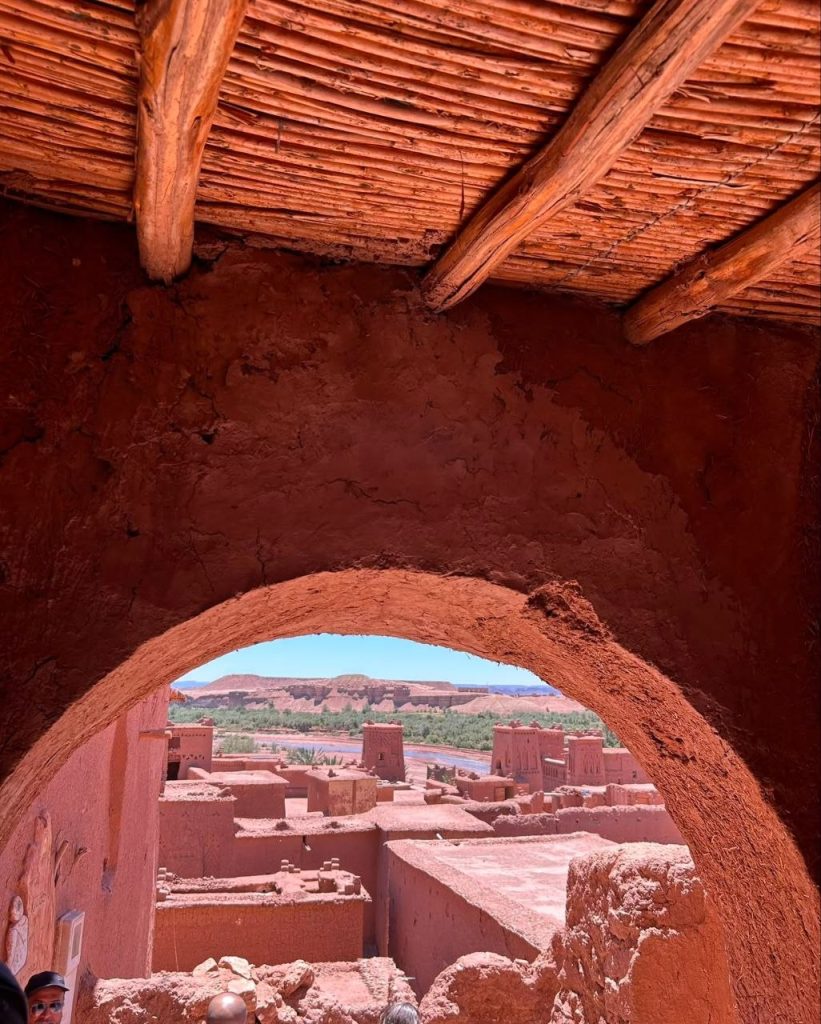
A fortified mud-brick village — a ksar — stacked up a hillside on the old caravan route between the Sahara and Marrakech, and a UNESCO World Heritage site since 1987. Its towers and granary have stood in for ancient cities in dozens of films, and a handful of families still live inside the walls.

How old is Aït Ben Haddou?+

The site has been a caravan stop since around the 11th century, though earthen buildings need constant renewal — most of the structures standing today date from the 17th century onward, repaired generation after generation in the same mud-brick technique.

Is Aït Ben Haddou worth visiting?+

Yes — it is the finest ksar in Morocco, and the reason it appears in every film shot here. The key is timing: early morning or golden hour, before or after the day-trip wave, climbing the lanes to the granary viewpoint. It is best folded into a desert route rather than rushed as a photo stop.

How long is the drive from Marrakech to Aït Ben Haddou?+

About 3 and a half to 4 hours for roughly 185 km — the road crosses the High Atlas at the Tizi n'Tichka pass (2,260 m), which is an attraction in itself. It works as a long day trip with Ouarzazate, and even better as day one of a desert circuit.

More answers in the “Ouarzazate & kasbah country” chapter of our Travel FAQ →

Turn the reading into a journey

The private tours below pass through the places this guide talks about — every departure is yours alone, on your dates.

Visit it on a private tour — WhatsApp