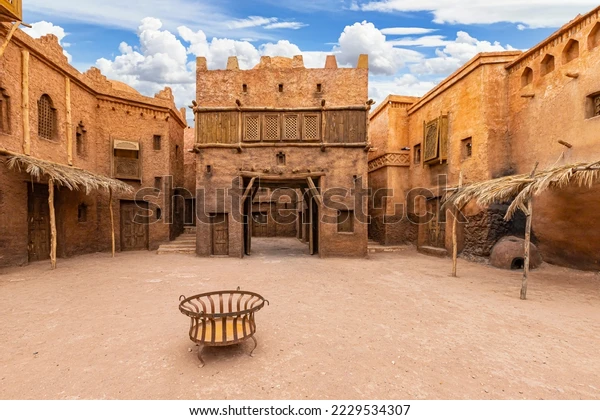
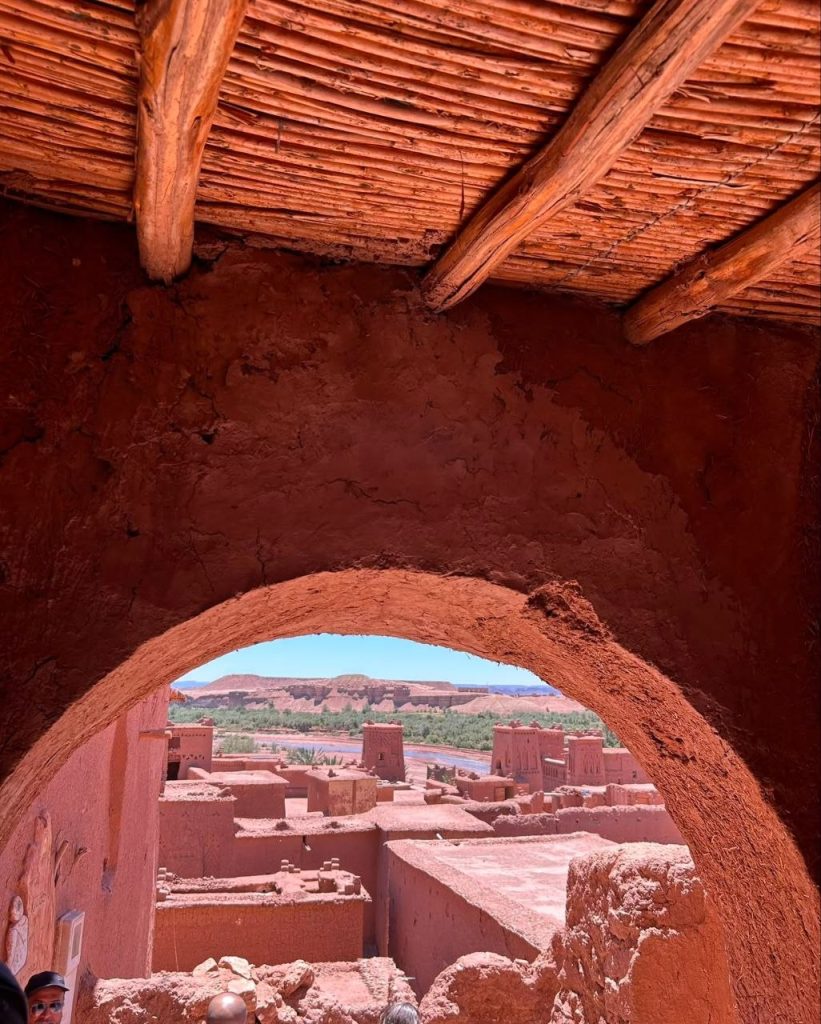
Before the film studios, Ouarzazate’s importance stood in pisé: Taourirt, the kasbah commanding the crossroads where the Draa, Dades and Marrakech roads meet. Under the Glaoui it housed hundreds — family, retainers, storerooms — in a hive of nearly three hundred rooms whose finest floors keep their painted ceilings and cedar lattices.
Restoration campaigns (with UNESCO involvement) have stabilised the showpiece apartments, and wandering the maze — stairways to nowhere, light wells, sudden painted salons — is the best crash course in how kasbah life actually worked. The neighbouring lanes still house craftsmen; the terrace views run to the Atlas one way and kasbah-country the other.
Allow 45 minutes, plus the artisan quarter. Taourirt slots into any desert itinerary’s Ouarzazate hour — our Ouarzazate day trip (from €30/person) and every Sahara circuit pass its gates, with Amridil and Aït Ben Haddou completing the great earthen trio.
Key facts
- Glaoui-era kasbah at the desert crossroads
- ~300 rooms; painted ceilings in the restored apartments
- UNESCO-assisted restoration of the showpiece floors
- Allow ~45 min + the artisan lanes
- Entry ticket on site; guides available at the door
Good to know
Go early or late — tour-bus noon flattens the atmosphere. The rooftop terraces are the photo; the painted salons are the reason.
Questions travellers ask
What is Aït Ben Haddou?+
A fortified mud-brick village — a ksar — stacked up a hillside on the old caravan route between the Sahara and Marrakech, and a UNESCO World Heritage site since 1987. Its towers and granary have stood in for ancient cities in dozens of films, and a handful of families still live inside the walls.
How old is Aït Ben Haddou?+
The site has been a caravan stop since around the 11th century, though earthen buildings need constant renewal — most of the structures standing today date from the 17th century onward, repaired generation after generation in the same mud-brick technique.
Is Aït Ben Haddou worth visiting?+
Yes — it is the finest ksar in Morocco, and the reason it appears in every film shot here. The key is timing: early morning or golden hour, before or after the day-trip wave, climbing the lanes to the granary viewpoint. It is best folded into a desert route rather than rushed as a photo stop.
How long is the drive from Marrakech to Aït Ben Haddou?+
About 3 and a half to 4 hours for roughly 185 km — the road crosses the High Atlas at the Tizi n'Tichka pass (2,260 m), which is an attraction in itself. It works as a long day trip with Ouarzazate, and even better as day one of a desert circuit.
More answers in the “Ouarzazate & kasbah country” chapter of our Travel FAQ →