★★★★★ Rated 4.5/5 — 204 Google reviews · 576 reviews · 5.0/5 on Tripadvisor · Written by a licensed Marrakech tour operator, on the road since 2011
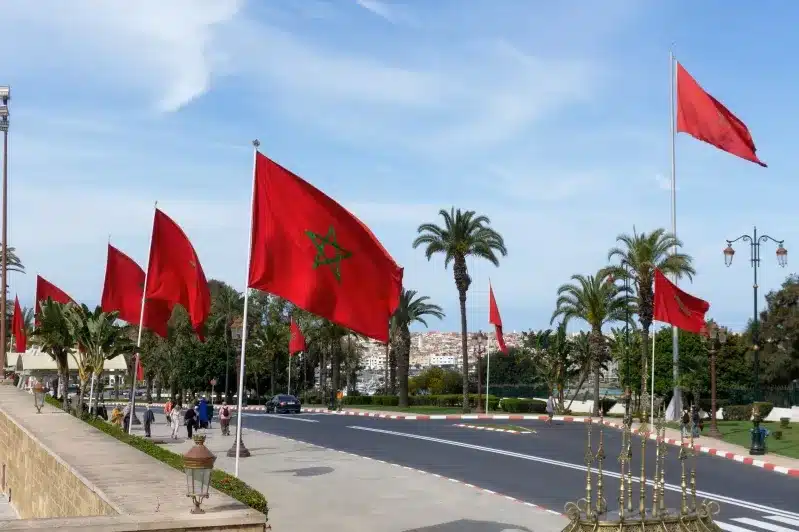
Morocco’s flag is a deep red field carrying a single five-pointed green star — one of the world’s most instantly readable national flags, and older in its elements than in its design. The red has flown over Morocco for centuries as the colour of the ruling sharifian dynasties, who trace descent from the Prophet; the interlaced green star — the Seal of Solomon (khatam) — was added in 1915, during the reign of Sultan Moulay Yusuf, to distinguish Morocco’s red banner at sea. Green is Islam’s colour; the five points are popularly read as the five pillars of the faith; and the star is drawn interlaced, like a knot of rope, not as a solid shape. This guide unpacks what each element carries, the flag’s history and protocol, where travellers meet it at its most spectacular — and the Guinness record it holds.
The red field: dynasty before design
Centuries before flags were standardised, plain red banners marked Moroccan sovereignty — the colour of the sharifian houses, including the Alaouite dynasty that has reigned since the 17th century and reigns today. When you see the deep red repeated on royal guards’ uniforms, city walls’ pennants and the national teams’ kits, you are looking at the oldest layer of Moroccan visual identity.
The green star: 1915, and what it means
The five-pointed interlaced star — the khatam, or Seal of Solomon — entered the flag in 1915 under Sultan Moulay Yusuf, giving the old red banner a unique mark among the world’s ensigns. The readings stack comfortably: green as the colour of Islam; five points for the five pillars; the interlacing as a protective knot, the same instinct that puts the khamsa — the hand of Fatima — over Moroccan doorways. Protocol note: the star is always drawn interlaced and always points up; the flag’s proportions are 2:3.
A Guinness record, and where you’ll see the flag best
Morocco holds the record for the largest flag ever made: a 60,409 m² national flag unfurled at Dakhla in 2010 — roughly eight football pitches of red and green. At travel scale, the flag is at its most photogenic over the kasbahs and official buildings of Rabat, along Marrakech’s ramparts on national days, and snapping in the Atlantic wind on Essaouira’s Skala. National holidays — Throne Day (30 July) and Independence Day (18 November) — dress whole boulevards in it.
Flag questions, answered
What do the colours of the Moroccan flag mean?
Red for the sharifian dynasties and the monarchy’s centuries of continuity; green for Islam, carried by the five-pointed Seal of Solomon.
Why is the star interlaced?
It is drawn as a continuous knot — a protective, geometric form deep in Moroccan and wider Islamic design, cousin to the zellige patterns and the khamsa.
How old is the flag?
The red field is centuries old as a royal banner; the current design with the green star dates to 1915 and has flown unchanged since — through the protectorate, to independence in 1956, to today.
Is it the only flag with a pentagram?
It is the best-known national flag built on one — and Morocco’s is interlaced, which is precisely what makes it unmistakable.
Everything on this page can be woven into a private itinerary — start from historical sites of Morocco or book the 7-day Imperial Cities circuit, and we shape the rest around you.
Zineb Lahlou — Zineb writes about Moroccan traditions, crafts and celebrations. She grew up between Fes and Casablanca in a family where every wedding involved three cities' worth of relatives, which turned out to be excellent training for explaining Moroccan social life to visitors. Her beat runs from zellij workshops to Gnaoua music to the etiquette of a hammam.