★★★★★ Rated 4.5/5 — 204 Google reviews · 576 reviews · 5.0/5 on Tripadvisor · Written by a licensed Marrakech tour operator, on the road since 2011
Why has Morocco pulled artists in for two centuries? Because the light is a material here: Delacroix filled seven notebooks in six months in 1832 and painted from them for the rest of his life; Matisse’s two Tangier winters (1912–13) rewired his colour; Yves Saint Laurent anchored his imagination — and his ashes — in the Majorelle Garden’s cobalt. The country still works on painters, photographers and writers the same way: Chefchaouen is a ready-made palette study, Essaouira an art colony with a fishing port attached, the Sahara a masterclass in negative space, and the medinas an infinite seminar in pattern. This guide maps Morocco for the working artist — where the light does what, hour by hour; which towns keep galleries, workshops and residencies of spirit; and how to build an itinerary with enough stillness to actually produce something.
The lineage: who worked here, and what they took
Delacroix’s 1832 Morocco journey is one of art history’s great raids: six months, seven notebooks, and decades of Parisian canvases mined from them — he called the country “a place made for painters”. Eighty years later Matisse wintered twice in Tangier and came home with a liberated palette; the blues and greens of his Moroccan canvases mark one of modernism’s hinges. The mid-century brought the writers — Bowles above Tangier’s bay, the Beats passing through — and the couturiers: Saint Laurent bought the Majorelle Garden with Pierre Bergé in 1980, saved it, and left his colour-world forever associated with its cobalt. The lesson threading all of them: Morocco rewards artists who stay long enough to stop photographing and start seeing.

The painters’ towns
Tangier is the ancestral studio — Delacroix’s and Matisse’s city, keeper of a diagonal northern light, with the American Legation’s art rooms as pilgrimage. Chefchaouen offers what no exercise can simulate: one hue declined across a thousand surfaces — work it at 7am before the lanes fill, and again at dusk from the Spanish Mosque path. Essaouira is the living colony: galleries seeded through the medina, Gnaoua trance in the air each June festival, thuya carvers to draw, and an Atlantic light that stays cool and silver all day — the anti-Marrakech, and most painters’ favourite anchor.

The photographers’ country, hour by hour
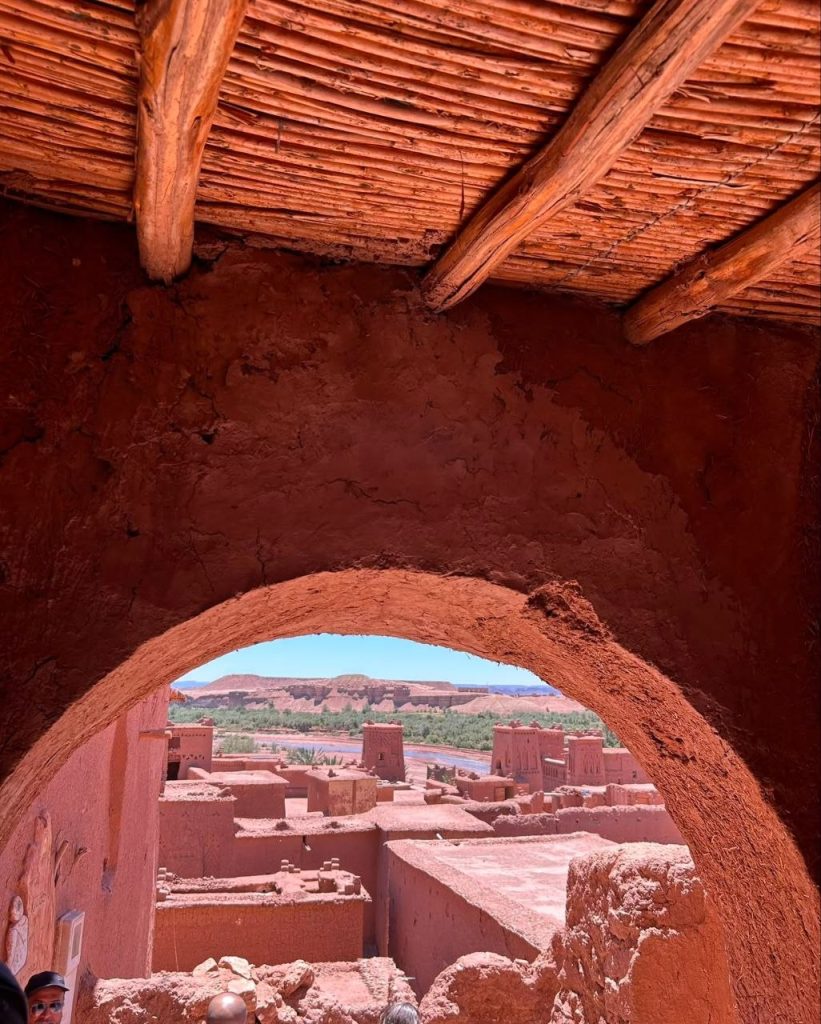
Morocco photographs best at its edges — of the day and of the map. Dawn: the dunes (Erg Chebbi for abstraction, Chigaga for wilderness), empty medina lanes, the Majorelle before opening. Midday — the enemy — belongs to interiors: madrasa courtyards, museum light-wells, the tannery terraces where the pits read as palettes. Golden hour: the kasbah road’s earthen architecture going red to gold, the Agafay’s lunar minimalism 45 minutes from Marrakech — we run a dedicated golden-hour shoot there (from €230) with a photographer who knows the plateaus’ angles. Blue hour: Jemaa el-Fna from a rooftop as the grills ignite — the most-photographed square in Africa, still inexhaustible.
Pattern school: what the medinas teach
Islamic Morocco’s visual language is geometry, calligraphy and repeat — and the medinas are its open textbook. The madrasas of Fes and Marrakech (Bou Inania, Ben Youssef) are the graduate course; the living workshops are the seminar. On the 12-day Artisans tour you sit with the zellige cutter assembling patterns face-down from memory, the kilim weavers, the lamp maker whose cut glass projects geometry across walls — sketchbooks welcome everywhere, several crafts practised hands-on. For an artist, it is the rare tour that doubles as technique study.
A working week in Essaouira: the self-made residency
The template our artist travellers settle into: a medina riad with roof access (your north-light studio), dawns on the Skala or at the port as the blue fleet unloads — the two inexhaustible subjects — middays for gallery rounds, thuya workshops and the sketchbook café shift on Place Moulay Hassan, golden hours on the beach as the kitesurfers turn to silhouettes, and one day-trip inland to the argan country for the goats-in-trees study nobody believes until they draw it. June adds the Gnaoua festival’s trance rhythms; winter adds storm light the Impressionists would have fought over. A week there with mornings protected produces more finished work than a month of touring.
What to pack for the light
Painters: a limited warm-biased palette travels best — the country will push your ochres, blues and pinks anyway; a pochade box beats an easel in medina lanes; cold-press blocks over stretched paper (the south is dry, the coast is not). Photographers: one fast prime for the lanes, a polariser for the desert’s noon, dust protection that you will actually use at Erg Chebbi, and the discipline of asking before portraits — a smile and a shown screen earn more faces than a long lens steals. Everyone: the golden hours are the workday; plan sleep, meals and transfers around them, which is exactly what a private route makes possible.
The five journeys we built for working artists
Everything this guide describes now exists as bookable routes: The Writer’s Silence (7 days, from €1050 — protected mornings, Atlas to desert), The Painter’s Light (8 days, from €1200 — four anchored Essaouira nights and the Oualidia lagoon), The Berber Villages Sketchbook (6 days, from €900 — gîtes, a mule for the art bag, Telouet’s kasbahs), Sahara Deep Silence (6 days, from €900 — two fixed nights at the same Chigaga camp), and In the Footsteps of the Artists (10 days, from €1500 — Tangier to Essaouira on the painters’ actual ground). All self-directed: no tutors, no group easels — logistics engineered around light and silence instead.
Travelling to produce, not just to see
The enemy of work is the transfer-heavy itinerary: you cannot paint from a moving seat. Artists do better with anchor stays — two to three nights minimum per place, Essaouira and Chefchaouen rewarding the longest — and a private route turns the vehicle into a studio schedule: stop where the light stops you, hold the viewpoint until the cloud does its work. Any of our 64 circuits can be re-paced around working hours; the 10-day Signature tour‘s unhurried shape (Marrakech, the Atlas, Essaouira, the Oualidia lagoon) adapts most naturally, and the no-desert design leaves the golden hours where you can use them. Send your medium and your dates on WhatsApp — the itinerary that returns will be built around hours of light, not lists of sights.
Questions artists ask about Morocco
Did Churchill really paint in Morocco?
Famously: after the 1943 Casablanca Conference he brought Roosevelt to Marrakech to watch the Atlas sunset, then painted the Koutoubia from the city’s edge — the only painting he completed during the entire war — and gave it to FDR. He called Marrakech ‘the loveliest spot in the whole world’, and did much of his painting from La Mamounia.
Are there artist residencies in Morocco?
Yes — Marrakech, Essaouira and Tangier all host residency programmes and artist-run spaces, with Essaouira’s gallery scene the most accessible entry point. For self-directed work, the anchor-stay approach — two to three nights minimum per town on a private route — functions as a residency you design yourself.
Which photographers made Morocco famous?
Harry Gruyaert’s saturated Magnum work is the modern benchmark — his Morocco images helped legitimise colour photography itself. The lineage runs back through the Orientalist painters to Delacroix’s notebooks. See it curated at Marrakech’s Maison de la Photographie, then walk out and shoot the same light.
Is there a photography museum in Morocco?
Marrakech’s Maison de la Photographie, in the medina, holds a fine historic collection with a rooftop café view worth the visit alone. Pair it with the Yves Saint Laurent Museum and the Majorelle’s Berber art hall for a full visual-culture day.
Do you run photography tours?
We run a dedicated golden-hour photoshoot in the Agafay (from €230 with a pro photographer), and any private circuit re-paces as a photography route — the vehicle stops where the light stops you, which no scheduled tour can promise. State your medium when you write; the itinerary adapts to it.
Everything on this page can be woven into a private itinerary — start from historical sites of Morocco or book the 7-day Imperial Cities circuit, and we shape the rest around you.