★★★★★ Rated 4.5/5 — 204 Google reviews · 576 reviews · 5.0/5 on Tripadvisor · Written by a licensed Marrakech tour operator, on the road since 2011
On Monday 2 August 2027, the longest total solar eclipse over land this century passes directly across northern Morocco. In Tangier — almost exactly on the centerline — the Moon covers the Sun from 09:44:47 to 09:49:38 local time: four minutes and fifty seconds of full darkness in a morning sky, with the Sun a comfortable 38 degrees above the horizon. Tétouan gets essentially the same; Chefchaouen, the blue city, stands inside the path with over four minutes of totality of its own. Nowhere else along the line from Spain to Egypt does the path cross a country that combines August skies this reliable, a real city this close to the centerline, and this much room left to book. This guide gives the exact timings city by city, where to stand, how to watch safely, and why the hotels of the north will be full long before the summer of 2027.
What happens on 2 August 2027
A total solar eclipse is the rarest ordinary-sky event there is: the Moon fits exactly over the Sun, day becomes deep twilight, the solar corona — the Sun’s outer atmosphere, invisible at any other time — hangs silver around a black disc, bright planets appear, and the horizon glows like sunset in all directions at once. Photographs have never done it justice; people who have stood in one plan their lives around the next.
The 2027 eclipse is special even among totalities. Its maximum duration — 6 minutes 23 seconds, reached over Egypt — makes it the longest total eclipse over land in the 21st century, which is why astronomers have been calling it the eclipse of the century since the dates were computed. The path of totality runs from the Atlantic through southern Spain, across the Strait of Gibraltar, over northern Morocco, then along North Africa to Egypt and the Red Sea. Morocco is the first country in Africa to receive it — mid-morning, high sun, full summer.

The eclipse over Morocco, city by city
| Place | In the path? | Totality lasts | Timing (local) |
|---|---|---|---|
| Tangier | Yes — almost on the centerline | About 4 min 50 s | Partial from ~08:40; totality 09:44:47–09:49:38; maximum 09:47 |
| Tétouan | Yes — just across the centerline | About 4 min 50 s | Within seconds of Tangier |
| Chefchaouen | Yes — between centerline and southern limit | About 4 min 14 s | A few moments after Tangier |
| Asilah & the Atlantic coast south of Tangier | Yes | Close to Tangier’s | Mid-morning |
| Oujda | Yes — near the southern edge | About 1 min 05 s | Mid-morning |
| Rabat, Fes, Casablanca, Marrakech | No — deep partial eclipse only | — | The Sun dims but never goes out: no corona, no darkness |
That last row matters more than any other. A 95 % partial eclipse is not 95 % of the experience — it is a dimmer morning. Totality is binary: either you are inside the path and the Sun goes out, or you are not and it never does. If you will be in Morocco that week, the only decision that counts is to be north of the line by the morning of 2 August.
Why Morocco is the smart place to stand
Every eclipse chaser faces the same equation: duration × cloud odds × logistics. Morocco scores remarkably on all three. The duration in Tangier is within ninety seconds of the global maximum. August cloud statistics in northern Morocco are among the most reliable anywhere on the path — this is the dry season, on a coast famous for clear summer mornings. And the logistics are the quiet advantage: southern Spain’s path cities have been booking out for years at eclipse-event prices, while Tangier — a city of a million people with a modern hotel stock, an intercontinental ferry port and its own airport — still has room. The Tarifa ferry puts Spain-based travellers in the centerline city in about an hour; Tangier’s airport connects across Europe; and the Al Boraq high-speed rail links the rest of Morocco to the path.
There is also the simplest argument of all: an eclipse lasts five minutes, and the trip around it lasts a week. Morocco wraps the five minutes in Cap Spartel, the ramparts of Asilah, the UNESCO medina of Tétouan, the blue lanes of Chefchaouen — which themselves stood in the darkness — and, for those who continue south, Fes and the Sahara.
Where exactly to watch
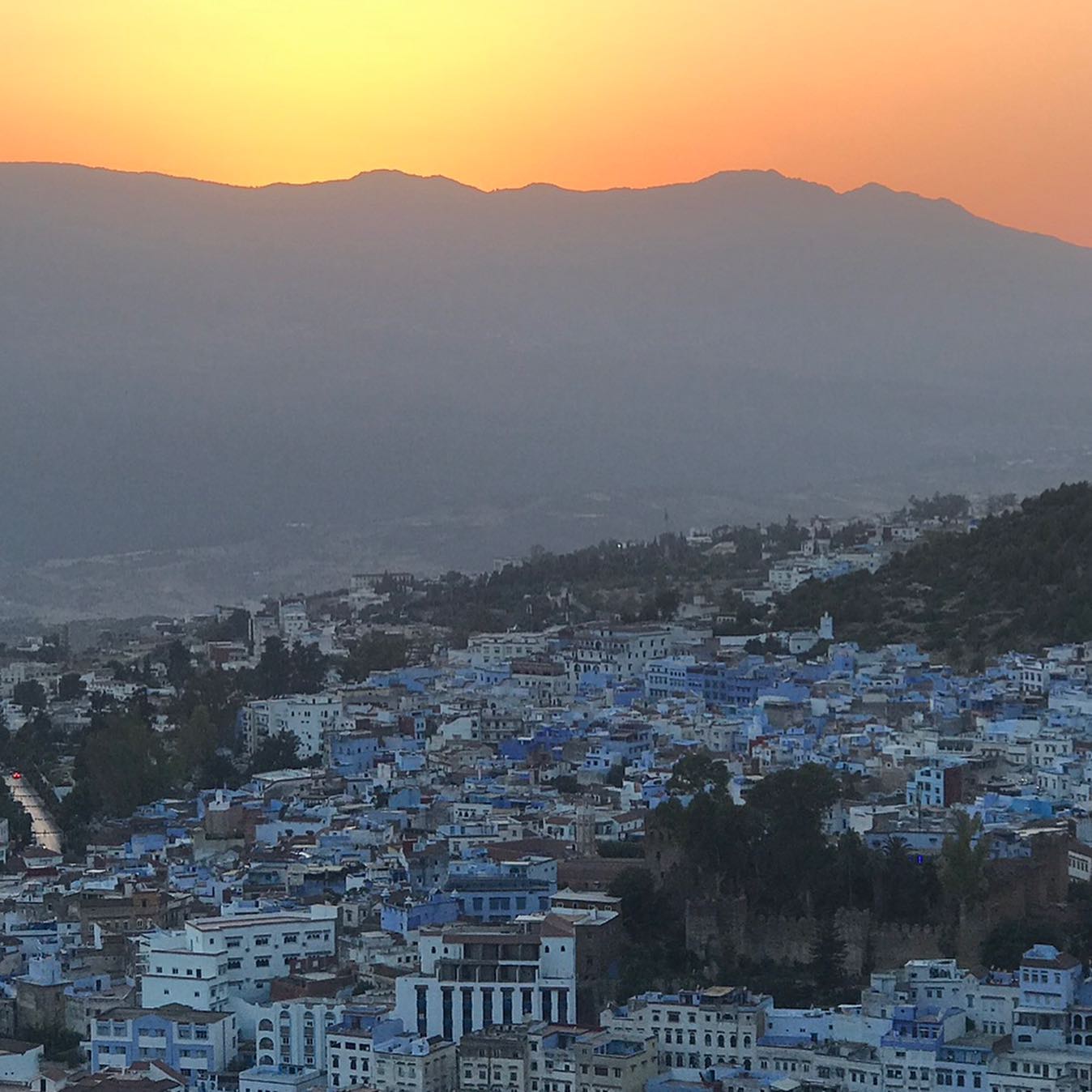
The centerline south of Tangier is the purist’s answer: maximum duration, open horizons, minutes from the city. This is where our own tour stands, on a point scouted and visited with guests the day before. The Atlantic coast around Asilah offers the same sky with the ocean as a stage — watch the Moon’s shadow arrive across the water. Tangier itself works beautifully for those who want the city experience: rooftops, the kasbah, a hundred thousand people falling silent at once. And Chefchaouen is the romantic’s choice — four minutes of night over a blue city, at the cost of half a minute of totality.
Wherever you stand, the rule is the same: be in position early. The roads north will carry the heaviest traffic Morocco has ever seen on an August morning, and totality waits for no one.
Watching safely
The Sun is never safe to look at directly — except during the minutes of totality itself, when the Moon covers it completely and the corona is the whole point. Before and after, certified eclipse glasses meeting the ISO 12312-2 standard are mandatory: ordinary sunglasses, smoked glass and phone filters protect nothing. Buy glasses from a reputable source well ahead (counterfeits flooded the market before recent eclipses), keep them on for every partial phase, and brief children carefully. On our departures, certified glasses are handed to every guest with a proper briefing the evening before.
The warning every guide gives too late: book now
Eclipse accommodation follows one law: the path books out first, early and expensively. Southern Spain is already demonstrating it. Northern Morocco’s capacity is larger than most of the path’s — but 2 August 2027 will still be the most in-demand night in the region’s history, and the good riads, the licensed guides and the private vehicles will be committed long before eclipse summer. If this event is on your list, the planning window is open now and will not stay open.
How we run it
Our 5-day Morocco Total Solar Eclipse Tour (from €750 per person) is built so that eclipse morning holds no unknowns: three nights in Tangier and one in a Chefchaouen medina guesthouse, half-board; a private vehicle and driver throughout; certified ISO 12312-2 glasses for every guest; the viewing point on the centerline visited together the day before; and an early private transfer on the morning itself — with the flexibility of an inland plan B that no coach group can match if the coast wakes up hazy. Around the main event: Cap Spartel, Asilah, Tétouan and Chefchaouen. The route extends south to Fes or the Sahara on request, and pairs naturally with the ferry from Spain. For travellers arranging their own stay, we also provide private chauffeur service for eclipse-morning logistics.
Questions travellers ask about the 2027 eclipse in Morocco
When exactly is the eclipse in Morocco?
Monday 2 August 2027, mid-morning. In Tangier the partial phase begins around 08:40, totality runs from 09:44:47 to 09:49:38 local time, and maximum eclipse is at 09:47 — with the Sun about 38° above the horizon.
Where in Morocco is the best place to see it?
The Tangier region. The centerline passes just south of the city, giving about 4 minutes 50 seconds of totality — within reach of the global maximum. Tétouan matches it; Chefchaouen, inside the path, gets about 4 minutes 14 seconds.
Can I see it from Marrakech, Fes or Casablanca?
Not the real thing. Those cities see only a deep partial eclipse — the morning dims, but the Sun never goes out and the corona never appears. Totality requires being inside the path, in the far north. It is the difference between reading about it and being there.
Do I need special glasses?
Yes — certified ISO 12312-2 eclipse glasses for every partial phase, for every person. Only during the minutes of totality itself is the naked eye safe (and that is when you should use it — the corona is the sight of a lifetime). Ordinary sunglasses protect nothing.
How early should I book?
Now is not too early. The path across southern Spain has been booking for years; northern Morocco has more capacity but will sell out well before summer 2027. Accommodation, licensed guides and private vehicles on 1–2 August will be the scarcest resources in the country.
Can I combine the eclipse with the Sahara or the imperial cities?
Naturally — that is how most of our eclipse guests travel. From Tangier the classic arc runs south through Chefchaouen and Volubilis to Fes, and on to the dunes. Send your dates on WhatsApp and the written itinerary — eclipse morning included, hotels named — comes back within the hour.
Everything on this page can be woven into a private itinerary — start from historical sites of Morocco or book the 7-day Imperial Cities circuit, and we shape the rest around you.