Home /Monuments of Morocco /High Atlas
Monuments of Morocco

Telouet Kasbah

High Atlas · Monument guide

★★★★★ Rated 4.5/5 — 204 Google reviews · 576 reviews · 5.0/5 on Tripadvisor · Visiting notes updated October 2026

  • Visited on our private tours — Your own licensed city guide
  • Real visiting notes — Hours, tickets and the quiet hours
  • Plan it on WhatsApp — Reply within 1 hour
  • Seat of the Glaoui — the 'Lords of the Atlas'
  • Ruined exterior hiding lavish painted salons
  • Abandoned after independence in 1956
Telouet Kasbah
Reply within 1 hour · no payment at this stage
Private departures only — never in a group

High on the old caravan pass south of Marrakech stands the most eloquent ruin in the Atlas: Telouet, seat of the Glaoui clan who ruled the south — and much of Morocco’s politics — until independence. From outside, weathering pisé; inside, the shock: reception salons of painted cedar, carved plaster and zellij as fine as any royal palace, maintained just enough to gleam in the half-light.

The contrast is the history lesson. The Glaoui gambled on the French protectorate, won unimaginable power, and lost everything at independence in 1956 — after which the palace was simply left. What survives is a monument to a vanished order, guarded by families who unlock the painted rooms for a small fee and a tip.

Telouet anchors the Ounila valley road — the slow, spectacular back way to Aït Ben Haddou through terraced villages and salt workings — which is exactly how our private Atlas & kasbahs circuits (from €300/person) route it. Allow 45 minutes inside; the rooftop view over the pass explains why the Glaoui chose the site.

Key facts
  • Seat of the Glaoui — the 'Lords of the Atlas'
  • Ruined exterior hiding lavish painted salons
  • Abandoned after independence in 1956
  • Gateway to the Ounila valley road to Aït Ben Haddou
  • Small entry fee to the keepers; allow ~45 minutes
Good to know

The detour from the Tichka road is the point — take the Ounila valley onward rather than backtracking. Rooms are dim: eyes adjust, photos need steady hands.

Questions travellers ask

What is Aït Ben Haddou?+

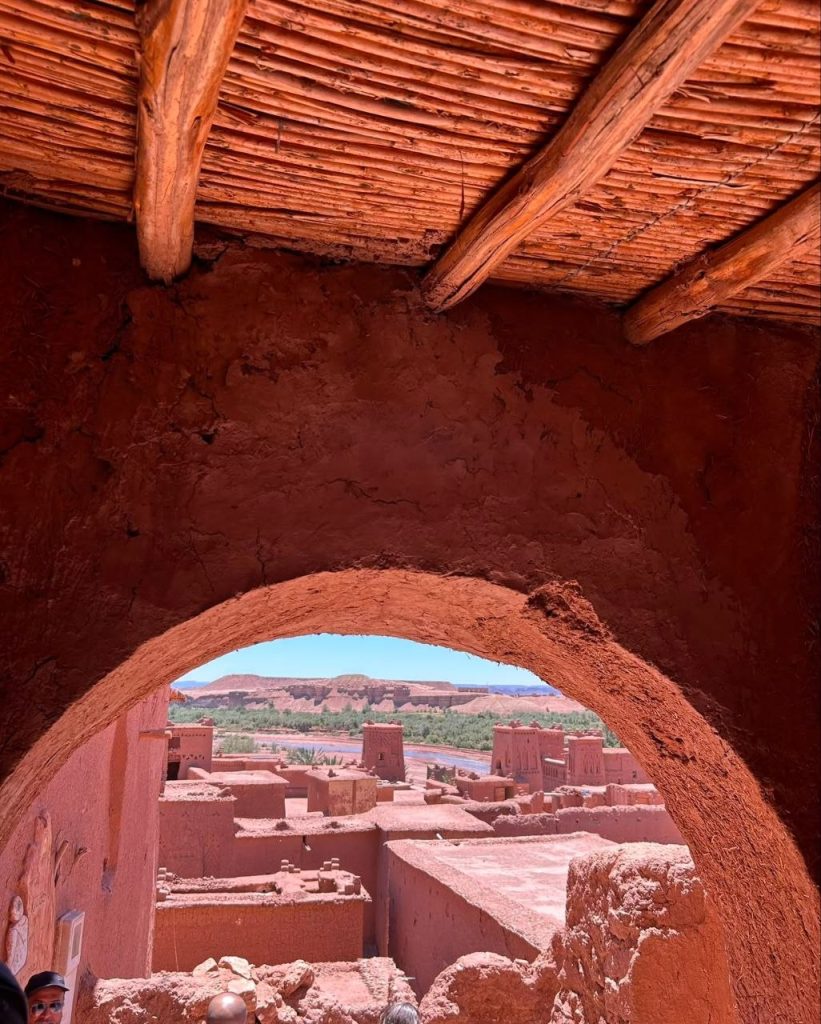
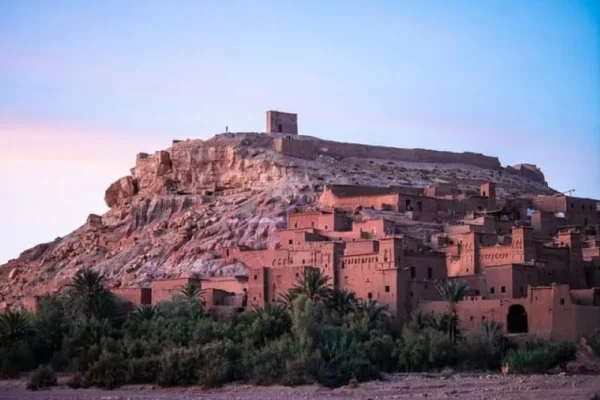
A fortified mud-brick village — a ksar — stacked up a hillside on the old caravan route between the Sahara and Marrakech, and a UNESCO World Heritage site since 1987. Its towers and granary have stood in for ancient cities in dozens of films, and a handful of families still live inside the walls.

How old is Aït Ben Haddou?+

The site has been a caravan stop since around the 11th century, though earthen buildings need constant renewal — most of the structures standing today date from the 17th century onward, repaired generation after generation in the same mud-brick technique.

Is Aït Ben Haddou worth visiting?+

Yes — it is the finest ksar in Morocco, and the reason it appears in every film shot here. The key is timing: early morning or golden hour, before or after the day-trip wave, climbing the lanes to the granary viewpoint. It is best folded into a desert route rather than rushed as a photo stop.

How long is the drive from Marrakech to Aït Ben Haddou?+

About 3 and a half to 4 hours for roughly 185 km — the road crosses the High Atlas at the Tizi n'Tichka pass (2,260 m), which is an attraction in itself. It works as a long day trip with Ouarzazate, and even better as day one of a desert circuit.

More answers in the “Ouarzazate & kasbah country” chapter of our Travel FAQ →

Turn the reading into a journey

The private tours below pass through the places this guide talks about — every departure is yours alone, on your dates.

Visit it on a private tour — WhatsApp