★★★★★ Rated 4.5/5 — 204 Google reviews · 576 reviews · 5.0/5 on Tripadvisor · Written by a licensed Marrakech tour operator, on the road since 2011
Is alcohol available in Morocco? Yes — legal and openly sold to visitors, within a system of its own: Morocco grows wine (the Guerrouane and Meknès region vineyards are genuinely good), brews its own beers, and serves both in licensed hotels, riad bars, tourist restaurants and the visible bar scenes of Marrakech’s Gueliz, Casablanca and the coastal towns. What changes from Europe is the discretion: no drinking in the street or public places, supermarkets sell only through dedicated licensed corners, and during Ramadan most of those corners close entirely while licensed tourist venues largely carry on. Prices run higher than the food around them — alcohol is taxed as the import-adjacent product it partly is. This guide covers where to buy and drink, what Moroccan wine is actually worth ordering, the Ramadan reality, and the etiquette that keeps it all comfortable.
Where you can drink, in practice
Licensed hotels and riads with bar licences; restaurants oriented to visitors (the licence is usually obvious from the wine list); and the established bar-and-rooftop scenes — Gueliz in Marrakech, central Casablanca, Tangier, Essaouira and Agadir on the coast. Traditional medina restaurants are usually dry by choice; the pattern is venue-by-venue, not city-by-city. Public drinking — street, beach, park — is both illegal and genuinely frowned upon: the system works precisely because consumption stays indoors.
Where you buy it: the supermarket corner
Large supermarkets (Carrefour, Atacadao and peers) sell beer, wine and spirits through a separate, licensed section — typically a corner or annex with its own till. Specialist cave shops exist in the big cities. Prices are noticeably above European supermarket levels, and selection thins fast outside the main cities — if a particular bottle matters to your desert nights, buy it in Marrakech before the road south.
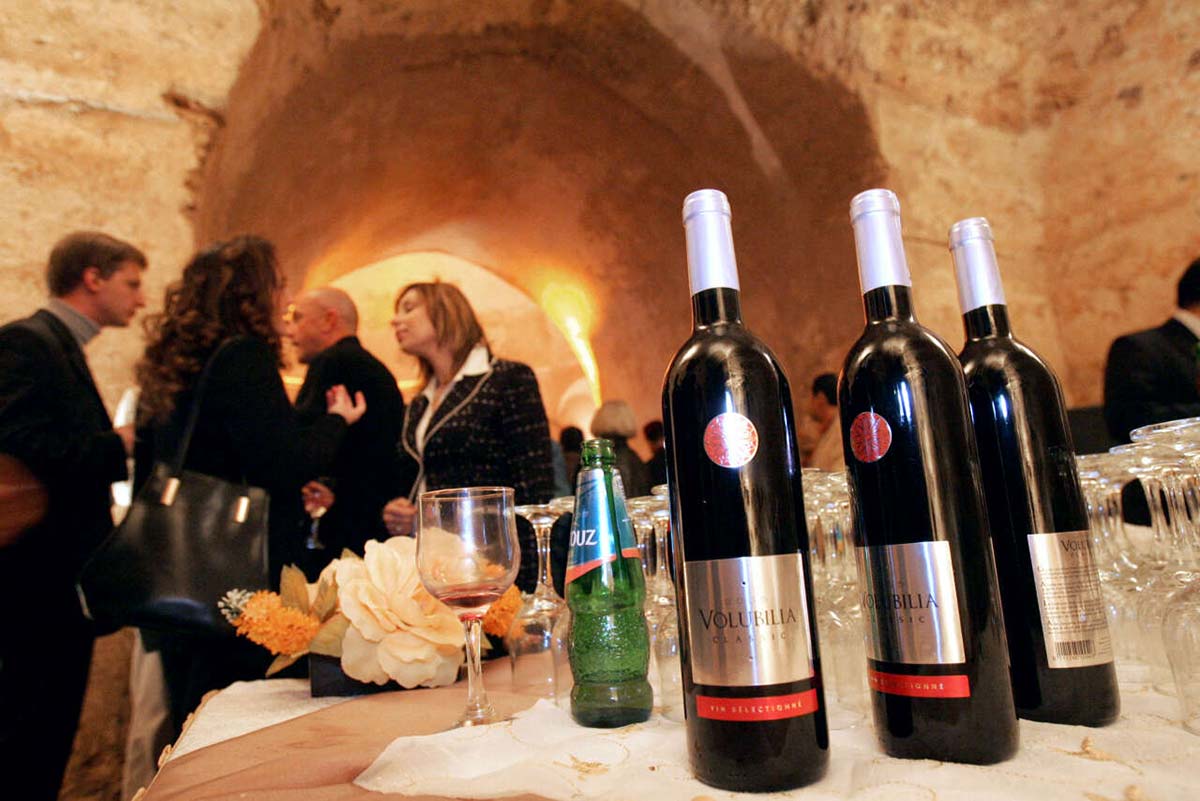
Moroccan wine is better than you expect
The vineyards around Meknès and the Guerrouane produce the country’s benchmark reds and the gris (pale rosé) that summer terraces run on; Boulaouane lends its name to the most famous gris of all. A winery afternoon in the Guerrouane is built into our 15-day luxury tour and the 7-day food tour — tasting at source remains the cheapest good wine in the country. Local beers (Casablanca, Flag, Spéciale) are honest lager territory and everywhere the licence allows.
Ramadan: the one month the rules move
During Ramadan the supermarket alcohol sections close — fully, for everyone — and many bars pause; licensed hotel and tourist-restaurant service largely continues for foreign guests, quietly. If your dates fall in Ramadan and the evening glass matters, plan around hotel bars and buy any bottles before the month starts. (The flip side: Ramadan nights in the medinas are among the best travel experiences Morocco offers.)
The questions travellers actually ask
Can tourists drink alcohol in Morocco?
Yes, legally and easily, in licensed venues — the system is built for exactly that. What it does not allow is public drinking.
Can I bring alcohol into Morocco?
Yes — adult travellers may bring a reasonable duty-free quantity (think a bottle of spirits and a bottle of wine, airport-duty-free scale). Checked luggage, sealed.
Can we have wine at a desert camp?
Often yes at private camps — policies vary by camp, so tell us when booking and we arrange it where the camp allows; many travellers simply pack their Marrakech bottle for the fireside. On our private circuits, say it at the quote stage and it is handled.
Is it disrespectful to drink here?
Not in licensed venues — that is what they are for. The respect line is public space and Ramadan daytime; hold those two and nobody will ever make you feel awkward.
And driving?
Treat it as zero-tolerance and don’t — which on our tours is academic, since the driver is ours and never drinks.
Everything on this page can be woven into a private itinerary — start from historical sites of Morocco or book the 7-day Imperial Cities circuit, and we shape the rest around you.
Abdellah Naciri — Abdellah covers culture and etiquette — the guest's guide to Moroccan life. His pieces explain the things locals rarely think to say out loud: how tea is offered and refused, what to wear where, how a moussem festival works, why Friday changes a town's rhythm. He writes them so that a first-time visitor can move through Morocco with ease rather than anxiety.