★★★★★ Rated 4.5/5 — 204 Google reviews · 576 reviews · 5.0/5 on Tripadvisor · Written by a licensed Marrakech tour operator, on the road since 2011
A khettara is Morocco’s underground irrigation channel — a gently sloping tunnel that walks water out of the mountains by gravity alone, no pumps and no open-air evaporation, surfacing exactly where an oasis needs it. The system starts at a mother well sunk to the water table at the foot of the mountains (the answer to the question travellers ask at the gorges: that is where the water originates), then runs for kilometres on a gradient slightly shallower than the land above, with vertical maintenance shafts every few dozen metres whose crater-rings of spoil give the desert surface its mysterious dotted lines. Every palm grove you admire between Marrakech, Skoura and the dunes exists because of this invisible engineering — the same family of technology as Iran’s qanats, worked here for roughly a thousand years. This guide explains how khettaras work, where to actually see one, and why the palm groves are exactly where they are.
How a khettara works, step by step
| Element | What it does |
|---|---|
| Mother well | The first and deepest shaft, sunk at the mountain foot until it taps the water table — the source of the whole system |
| The gallery | A hand-dug tunnel running kilometres toward the oasis at a gradient of barely a metre per kilometre — shallower than the surface slope, so the water eventually emerges |
| Vertical shafts | Access points every 20-50 m for digging and maintenance; their rings of excavated spoil are the lines of craters you see from the road (and from planes) |
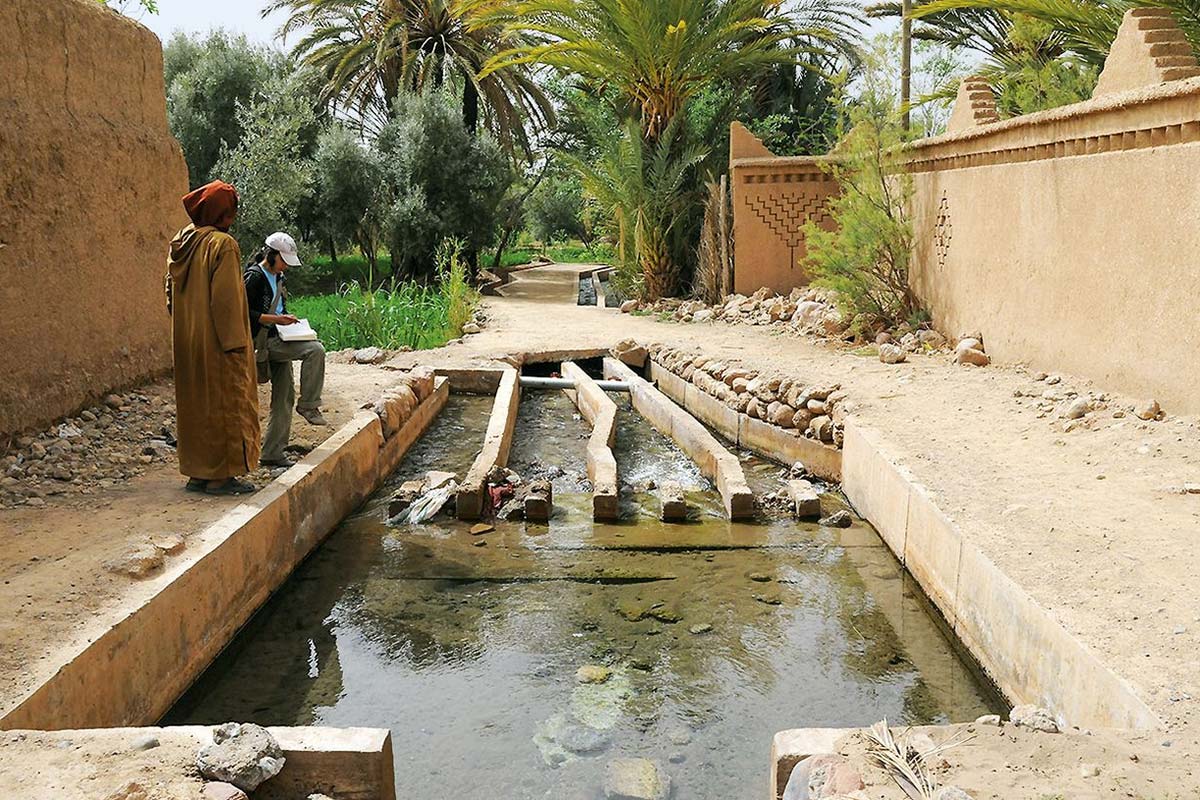
| The outlet | Where water surfaces into open channels (seguias) and the garden-sharing system divides it by hours among families |
The brilliance is what the design avoids: underground, the water neither evaporates in the Saharan air nor silts with sand, and gravity does all the work, forever, for free. The cost was human — khettara digging was specialist, dangerous labour, and the maintenance guilds that kept them alive were an institution of oasis society.
Where to actually see khettaras
The Skoura oasis is the best classroom: working palm gardens, visible shaft lines, and guesthouses inside the palmery itself — our Writer’s Silence retreat and the 11-day Chigaga immersion both sleep there, and a walk among the khettara-fed gardens is part of the day. The Marrakech palmery itself was khettara-built — a thousand-year-old irrigation project masquerading as scenery, which you float over on the sunrise balloon flight. And along the Road of a Thousand Kasbahs, the dotted crater-lines run beside the tarmac for kilometres; once your eye learns them, the desert never looks empty again.
Why the oases are exactly where they are
Trace any southern palm grove to its upstream end and you find the logic: a mountain front (Atlas or Anti-Atlas), a water table within digging reach, and a slope gentle enough for a gallery to beat the surface to the lowlands. Skoura, the Draa’s hundred-kilometre ribbon, the Ziz valley’s ksour — each is a khettara-and-river solution to the same equation. The caravan trade followed the water, the kasbahs rose to guard the trade, and the whole architecture of southern Morocco — the subject of our kasbah guide — stands on this hidden plumbing.
Questions travellers ask about khettaras
Where does the water in a khettara come from?
From the mother well — the deep first shaft at the mountain foot that taps the water table. Rain and snowmelt on the Atlas recharge it; the gallery then delivers it downhill by gravity alone.
How deep and how long are they?
Mother wells can reach tens of metres; galleries commonly run several kilometres — the longest Moroccan systems stretch over ten. All dug by hand.
Are khettaras still in use?
Some are, especially where communities maintain them; many have fallen dry as motor pumps lowered the water table — the quiet modern threat to a thousand-year-old system. The working ones in Skoura’s gardens are the ones to see.
Is a khettara the same as a qanat?
Same family of technology: Iran’s qanats are the ancestral form, and the technique travelled west across the Islamic world. Morocco’s khettaras are its far-western masterpieces.
Everything on this page can be woven into a private itinerary — start from historical sites of Morocco or book the 7-day Imperial Cities circuit, and we shape the rest around you.
Fatima Zahra Ouazzani — Fatima Zahra covers the desert south — Merzouga, Zagora, the Draa Valley and the oasis routes between them. Her writing keeps returning to the people of the region: the families who run the camps, the date harvest in autumn, the way a khettara irrigation channel organises an entire palm grove. She is our reference for travellers who want the Sahara with its context still attached.